
Where To Get A Custom 3D Printed Product Made In Vizag
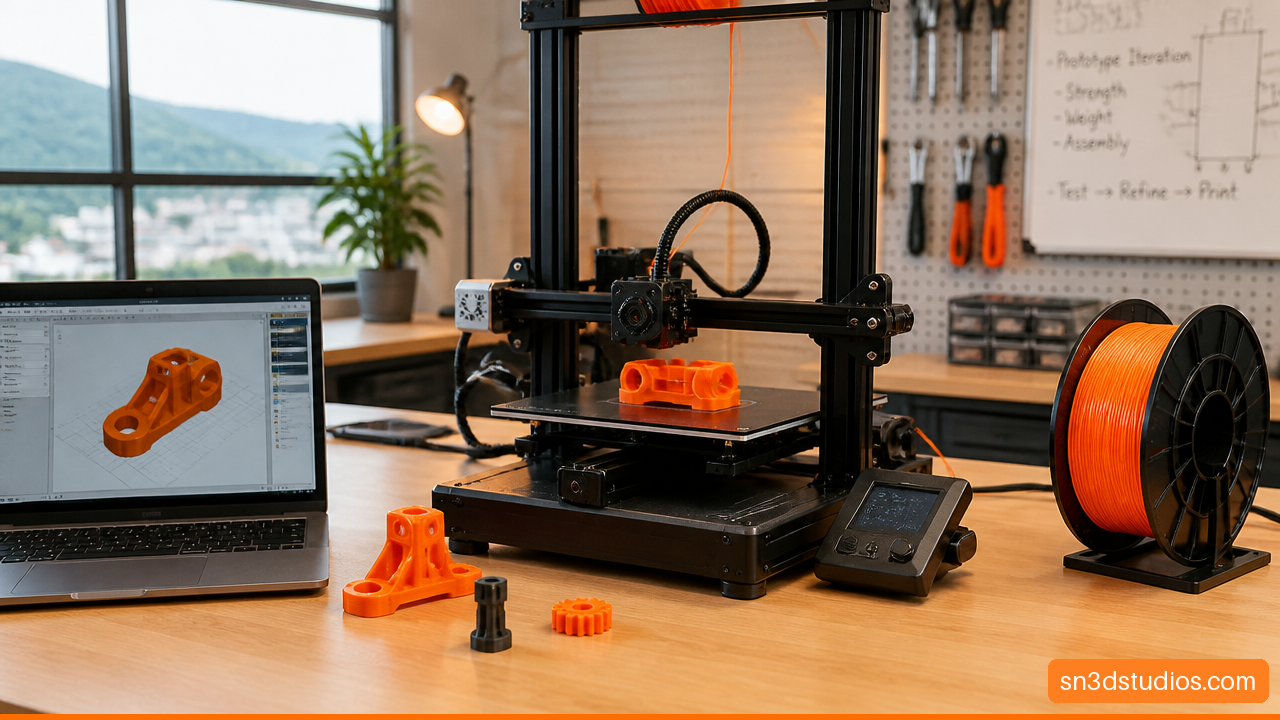
If you are wondering where to get a custom 3D printed product made in Vizag, start by matching the job to the right kind of provider. A custom keychain, a replacement knob, an engineering prototype, and a detailed miniature may all be 3D printed, but they do not need the same machine, material, design support, or finishing process.
Vizag has a mix of neighborhood focused print providers, design and scanning services, and industrial operations. The most reliable choice is rarely the one that simply says “3D printing.” It is the one that can confirm your material, dimensions, finish, timeline, and file readiness before you pay.
Table Of Contents
- Key Takeaways
- Choose The Right Vizag 3D Printing Provider
- Prepare Your Design And Select A Material
- Get A Clear Quote And Avoid Quality Problems
- Frequently Asked Questions
- Sources
Key Takeaways
• Small consumer items such as keychains, display models, miniatures, desk accessories, and simple stands are often a good fit for local FDM or resin printing providers.
• Functional parts such as enclosures, brackets, replacement pieces, and prototype housings need more discussion about strength, tolerance, heat, and how the part will be used.
• Industrial providers are better suited to demanding prototypes, batch production, advanced polymers, metal parts, and jobs where material documentation or tighter consistency matters.
• An STL file is usually the fastest starting point, but a sketch, photo, broken part, or rough dimensions can still be enough if the provider offers CAD design or 3D scanning.
• Do not accept a vague “it can be printed” answer. Ask what material will be used, how accuracy will be checked, whether supports will affect the surface, and what happens if the part does not fit.
A 3D printed product is not just a print job. It is a small manufacturing project with decisions about design, material, orientation, finishing, and inspection.
Choose The Right Vizag 3D Printing Provider
Start With The Type Of Product You Need
I would begin by describing the result you need rather than asking only for a price. Tell the provider whether the item is decorative, functional, load bearing, heat exposed, or meant to fit onto another object. That one explanation helps them recommend the correct process.
For example, a personalized miniature needs facial detail and a smooth visual finish. A replacement clip for a kitchen appliance needs toughness and a little flexibility. A prototype enclosure may need screw posts, cable openings, and enough accuracy for electronics to sit inside.
Local options appear to cover a broad range of needs. Justdial’s Vizag listings for design and printing services show providers across different parts of the city, which can make nearby consultation or pickup easier. Still, a directory listing should be treated as a starting point, not proof that every provider has the same machine, material, or finishing capability.
For smaller gift oriented orders, Vizag 3D Prints advertises personalized miniatures and custom keychains in Visakhapatnam. That can be a sensible route when appearance and personalization matter more than engineering certification or tight mechanical tolerances.
Consumer Grade Versus Industrial Grade Printing
The biggest decision is often whether you need a simple local print service or a more industrial production partner. Neither is automatically better. The right choice depends on what failure would cost you.
| Your Need | Usually Best Fit | Why It Matters |
|---|---|---|
| One keychain, figurine, nameplate, or display model | Consumer or small local provider | Lower complexity and often simpler communication |
| One replacement cap, bracket, holder, or enclosure | FDM focused provider with design support | Functional fit and material choice matter more than fine detail |
| Detailed dental style model, jewelry pattern, miniature, or smooth concept model | Resin capable provider | Resin processes can produce fine details and smoother surfaces |
| Product development prototype or repeatable small batch | Industrial provider | Better access to process choices, repeatability, and production planning |
| Nylon, metal, advanced polymer, or demanding engineering application | Industrial specialist | These jobs may require SLS, MJF, DMLS, or other higher end processes |
Industrial capability is relevant in Vizag, not just in larger metro cities. A report on think3D’s industrial facility in Vizag describes a setup intended for rapid prototyping and batch production across multiple printing technologies. This category makes more sense when you need several identical parts, stronger engineering materials, or a process that must be repeatable.
Fair warning: a sophisticated process is not always the right answer. Ordering an industrial nylon part for a simple cable clip may add cost without solving a real problem. On the other hand, choosing the cheapest decorative filament for a bracket inside a hot vehicle can lead to warping or breakage.
When To Use Design Help Or 3D Scanning
You do not need to arrive with a finished CAD model. Many custom fabrication projects begin with a hand sketch, reference photo, measurements, or an existing broken part.
A local service listing from Kreate3D includes both 3D printing and 3D scanning in Visakhapatnam, along with stated Monday through Saturday office hours. That combined workflow can be useful when the physical object matters as much as the digital file.
Use CAD modeling when you need to create something new or modify dimensions precisely. Use scanning when you need to capture the shape of an existing part that is hard to measure by hand. Scanning is especially useful for curved surfaces, irregular housings, worn parts, or objects that must sit against another component.
For instance, consider a damaged plastic cover that clips over a curved appliance body. A ruler may capture the length and width, but not the subtle curve or hidden clip locations. Scanning can provide a geometric starting point. The model may still need repair and redesign because a scan records surface shape, not necessarily the original engineering intent.
Prepare Your Design And Select A Material
Send A File That Can Actually Be Printed
An STL file is the most common format for 3D printing because it converts the object surface into a mesh the printer software can slice into layers. Other formats, such as STEP or OBJ, may be useful during design, but the provider should confirm what they accept.
Before sending a file, I recommend checking these details:
- Units: Confirm whether the model is in millimeters. A part designed in inches can arrive at the wrong size if units are misunderstood.
- Overall dimensions: State the required length, width, height, and any dimensions that must be exact.
- Wall thickness: Thin walls can crack, warp, or fail to print. The safe thickness depends on material and process.
- Moving or mating parts: Tell the provider where clearance is needed. Two parts that look separate on screen may fuse together if the gap is too small.
- Orientation sensitive surfaces: Identify which face should look best, because support structures and layer lines can affect the finish.
- Intended use: Explain whether the item will carry weight, flex, contact water, sit in sunlight, or face heat.
A common mistake is assuming that an attractive CAD render proves a design is printable. It does not. A model can have hidden holes, overlapping surfaces, ultra thin features, or unsupported overhangs. Good print preparation repairs the mesh, checks wall thickness, chooses a print orientation, generates supports where needed, and estimates time and material before printing begins.
Match The Material To The Job
Material selection controls more than color. It influences strength, surface finish, durability, temperature resistance, and price. Availability can vary by provider, so verify the actual material in stock for your order rather than relying on a general capabilities list.
| Material Or Process | Good Uses | Benefits | Watch Outs |
|---|---|---|---|
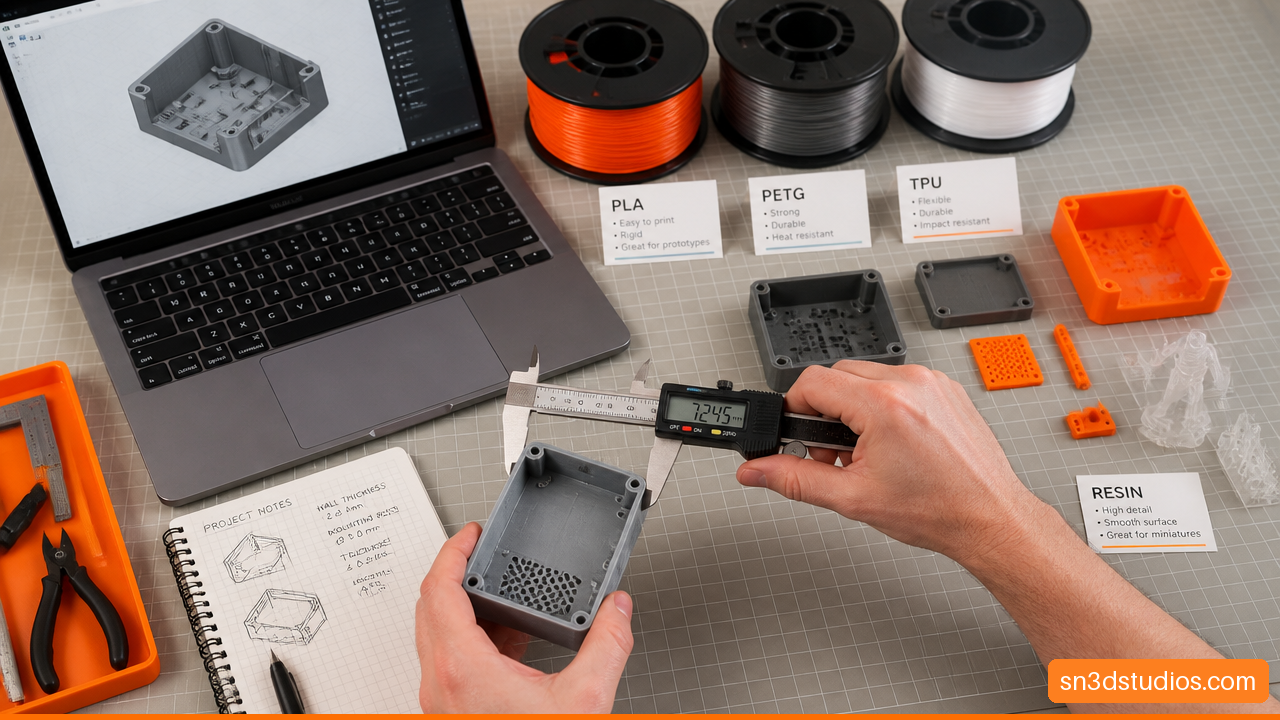
| PLA filament | Models, decor, prototypes, light duty objects | Affordable, easy to print, many color choices | Can soften in heat and may not suit stressed parts |
| PETG filament | Holders, brackets, containers, functional prototypes | More durable and moisture resistant than PLA | Surface finish may be less crisp than resin |
| ABS or ASA filament | Heat exposed enclosures and outdoor oriented parts | Better heat performance; ASA handles UV exposure well | Warping and fumes require controlled printing |
| TPU flexible filament | Bumpers, grips, gaskets, flexible covers | Rubber like flexibility | Dimension control and fine details can be harder |
| Resin, SLA, or DLP | Miniatures, display pieces, high detail models | Smooth surfaces and fine detail | Standard resins can be brittle; curing matters |
| Nylon via SLS or MJF | Strong functional parts and repeat batches | Tough, durable, and suited to complex shapes | Usually costs more than desktop filament printing |
| Metal via DMLS | Specialized components needing metal properties | Produces complex metal geometry | Requires industrial capability and post processing |
A local community post in r/Visakhapatnam says a seller specializes in high precision FDM work for enclosures, technical models, and part reproductions. That is a useful sign that functional printing is available locally, but the post is self reported, so verify the claimed FDM specialization directly before placing an order.
Build In Tolerance Instead Of Expecting A Perfect Press Fit
3D printing produces parts layer by layer. The material can shrink slightly, edges can round off, and holes may print smaller than expected. That does not make the process inaccurate. It means the design needs tolerance.
For a simple example, imagine a printed lid that must slide over a box measuring 50 mm wide. Designing the inner lid width at exactly 50 mm may create a part that is too tight. The provider may suggest extra clearance based on the printing process and material. The correct amount depends on the machine, orientation, and fit type, so there is no universal number that works for every part.
For critical assemblies, ask for a test piece first. A small sample section with the hole, clip, thread, or mating feature can be far cheaper than reprinting a large enclosure after discovering the fit is wrong.
Get A Clear Quote And Avoid Quality Problems
Ask Questions That Prevent Expensive Surprises
Custom 3D printing prices are difficult to compare from a single number because two seemingly similar parts can require very different work. Print time, material volume, supports, design labor, finishing, machine type, quantity, and urgency all affect the quote.
Before approving an order, ask these questions:
• What process and material will be used for this exact part?
• Are CAD modeling, file repair, scanning, supports, and finishing included or billed separately?
• What are the final dimensions, and which dimensions can the provider reasonably target?
• Will the print have visible layer lines, support marks, seams, or color variation?
• Can the provider send a digital preview, dimensions check, or sample before producing multiple units?
• What is the estimated production time after design approval, not just after first contact?
• If the print fails, warps, or does not match the approved file, what is the reprint process?
• Is pickup available, and how will courier damage or fit issues be handled?
These questions are especially useful for one off parts. A low initial quote can become less attractive if design changes, finishing, or a second print are added later.
Understand What Changes Turnaround Time
Some local sellers may complete straightforward FDM jobs quickly, while larger or more complex work can take longer. There is no reliable citywide turnaround promise because the actual lead time depends on the job and the provider’s queue.
The usual delay points are easy to understand:
- File repair or CAD work: A sketch must be modeled before it can be printed.
- Material availability: A provider may have standard filament but not a specific engineering material or resin color.
- Print duration: A tall, detailed part can run for many hours, especially at fine layer settings.
- Post processing: Removing supports, washing and curing resin, sanding, painting, or assembling parts adds time.
- Quality failure: Warping, weak layers, support damage, or a bad fit may require a revised print.
- Batch scheduling: Industrial machines may group jobs by material or process rather than run every order immediately.
If you need an item for an event or repair deadline, provide the date at the start and ask for a realistic approval deadline. “Need it by Friday” is less useful than “I need to collect it by 4 pm Friday, and I can approve the final design by Tuesday.”
Pickup Or Delivery: Choose Based On Risk
Pickup is often the safer choice for a first custom order, a fragile resin model, or a part that must fit another item. You can inspect the surface, confirm dimensions, and test basic fit before leaving. It also makes discussion easier if a reprint or adjustment is needed.
Delivery can be more convenient for standard items, repeat orders, or parts that are unlikely to need immediate fitting. Ask how the item will be packed, whether delicate sections are protected, and whether the provider will share tracking details.
For a replacement part, pickup has another advantage: bring the original object. A provider may be able to compare the print against the real mating surface. For a batch of simple branded keychains, courier delivery is usually a more practical tradeoff.
Inspect The Part Before Calling The Job Complete
Quality assurance does not need to be complicated. Check the features that matter to the intended use.
| Check | What To Look For | Why It Matters |
|---|---|---|
| Dimensions | Length, width, hole diameter, clip spacing | A small mismatch can stop parts from fitting |
| Surface | Support scars, rough layers, cracks, resin tackiness | These affect appearance and sometimes strength |
| Strength | Weak seams, bending, loose thin sections | Layer direction can change how a part breaks |
| Assembly | Screws, lids, connectors, moving sections | Fit problems are easiest to identify early |
| Finish | Color, paint, polish, texture, sharp edges | Cosmetic expectations should match the approved plan |
For complex prototypes, keep a short written record of changes between versions. Note what changed, why it changed, and what still needs testing. That turns a failed fit into useful product development rather than a vague complaint about a “bad print.”
Frequently Asked Questions
Can I Get One Custom 3D Printed Part Made In Vizag?
Yes. One off printing is commonly used for replacement pieces, miniatures, prototype parts, stands, and personalized products. Ask whether the provider has a minimum order value or a separate design fee, because a single custom part may require modeling and setup even when the material amount is small.
Do I Need An STL File Before Ordering?
No. An STL file speeds up the process, but you can often begin with a sketch, photo, dimensions, or existing object. If the provider offers CAD modeling or scanning, they may be able to create the printable model. Confirm the design cost and how many revisions are included before work begins.
Which Vizag Service Is Better For A Gift Or Miniature?
Choose a provider that specifically shows personalized products, miniatures, resin work, or finishing examples. For a gift, visual detail and surface quality are usually more important than industrial material performance. Request photos of comparable work if the final appearance matters.
Can A Broken Replacement Part Be Reverse Engineered?
Often, yes. A provider can measure, model, or scan an existing part and create a revised version. This works best when enough of the original part remains intact. If a clip or tab broke off completely, photos and mating dimensions may still help recreate it, but expect an iteration for fit.
How Much Does A Custom 3D Print Cost In Vizag?
There is no dependable single price range for all custom work. Small basic prints may cost far less than a part requiring CAD design, flexible material, resin finishing, metal printing, or multiple revisions. Request an itemized quote that separates design, printing, finishing, delivery, and taxes where applicable.
How Long Does A Custom 3D Print Take?
A simple print ready file may move quickly, but design work, material sourcing, long print duration, finishing, and reprints can extend the timeline. Get the estimated completion date after the provider has reviewed the model, not before. For deadline sensitive projects, allow time for at least one design correction.
Is FDM Or Resin Better For My Product?
Choose FDM for many functional parts, larger objects, and budget conscious prototypes. Choose resin when you need fine detail, smoother surfaces, or intricate small features. Neither process is automatically stronger or more accurate in every situation; the part’s purpose and material matter more than the label.
Is Pickup Better Than Courier Delivery?
Pickup is usually better for first time custom work, fragile items, and parts that need a fit check. Delivery is convenient for repeat jobs and simple products. If a part must attach to an existing object, take that object to the provider when possible.
Sources
- Justdial — Top 3D Designing Services in Vizag: https://www.justdial.com/Vizag/3D-Designing-Services/nct-11312516
- Vizag 3D Prints — Vizag 3D Prints: https://vizag3dprints.carrd.co/
- Kreate3D — 3D Printing and 3D Scanning services in Visakhapatnam: https://kreate3d.in/3d-printing-and-3d-scanning-services-in-visakhapatnam/
- 3D Printing news — think3D’s New Industrial 3D Printing Facility in Vizag, India: https://3dprinting.com/news/think3ds-new-industrial-3d-printing-facility-in-vizag-india/
- reddit.com: https://www.reddit.com/r/Visakhapatnam/comments/1jdz9hm/3d_printing_services/