
Startup 3D Printing Partner for Prototypes and Product Models
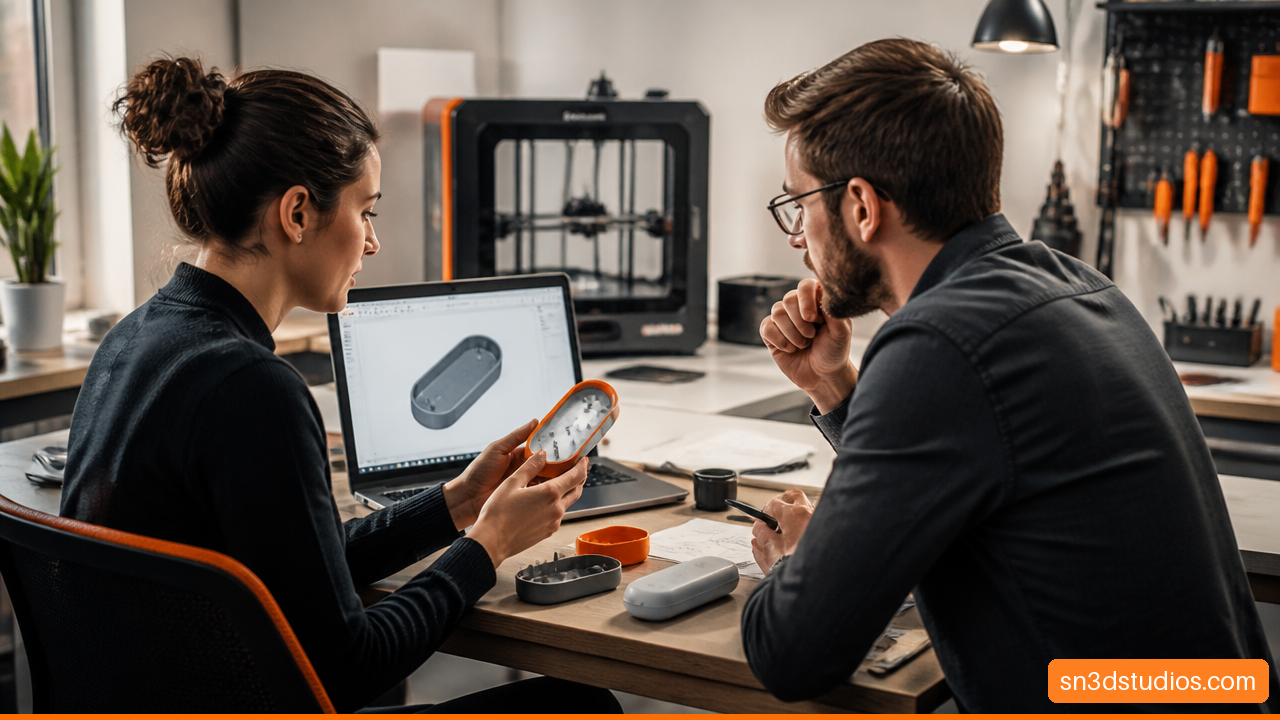
Choosing a startup 3D printing partner for prototypes and product models is not just about finding someone who can print a file. The right partner helps turn an idea, sketch, or CAD model into a physical part that answers a real question: Does it fit? Does it look right? Can it handle use? Is it ready for a small launch?
I would treat the first prototype as an engineering decision, not a shopping-cart purchase. A cheap print that cannot test the right feature may cost more than a better-planned part that prevents an extra design cycle.
Table Of Contents
• What A Startup Partner Should Provide
• Choose The Process For The Prototype Goal
• Control Cost, Quality, And Confidentiality
• Key Takeaways
• Frequently Asked Questions
What A Startup Partner Should Provide
A capable partner should provide more than machine access. The useful work starts before printing: reviewing the model, clarifying the purpose of the part, identifying possible print risks, and recommending a process and material that match the test.
Fresh Consulting’s rapid prototyping workflow describes a process that can include consultation, CAD review, technology selection, timeline planning, and budget review before fabrication. That is the model I would look for when a prototype will guide product decisions.
Start With The Question The Part Must Answer
A startup may need several versions of the same product model. Each serves a different purpose.
| Prototype Goal | What It Should Prove | Best Partner Focus |
|---|---|---|
| Appearance model | Form, color, surface quality, presentation | Fine detail, finishing, paint options |
| Fit-check part | Clearances, assembly, grip, placement | Accurate dimensions, CAD review |
| Functional prototype | Strength, movement, heat, or repeated use | Material properties and test planning |
| Pilot or low-volume unit | Repeatable build quality and traceability | Revision control and inspection |
For example, a product enclosure shown to investors may need clean surfaces and precise visual details. The same enclosure used to test snap fits needs a material and build direction that better reflect how the clips will flex. One file can produce both parts, but the print plan should not be identical.
Ask How The Partner Handles The Whole Workflow
A startup often benefits when the provider can support design changes and later manufacturing choices. Startup-focused prototyping services from 3DRM Tech show that support may extend across CAD, 3D scanning, CNC machining, and low-volume production, not only 3D printing.
This does not mean every project needs every service. It means the partner should explain what comes next if printing reveals a limitation. A printed bracket may validate its shape, while a later CNC version may be needed if the final product requires metal, tighter process control, or a production-like finish.
Use A Clear Prototype Brief
Before requesting a quote, send a brief that removes guesswork. Include:
- The CAD revision number and intended part quantity.
- The main purpose: appearance, fit, function, or customer demonstration.
- Critical dimensions, mating parts, and acceptable variation where known.
- Expected loads, heat, chemicals, or repeated movement for functional parts.
- Required finish, color, threaded inserts, assembly steps, and delivery deadline.
A STEP file is often useful because it keeps solid-model information that may help with design review. An STL file may be enough for a straightforward print, but it is a mesh and is less useful when the partner needs to inspect or edit design intent.
Choose The Process For The Prototype Goal
The best process depends on what the part must prove. There is no universal winner between FDM, SLA, and SLS.
Match Material Properties To The Test
| Process | Often A Good Fit For | Watch For |
|---|---|---|
| FDM | Early concept parts, larger forms, practical fit checks | Visible layers, support marks, direction-dependent strength |
| SLA | Detailed product models, fine text, smooth presentation parts | Some resins can be brittle; post-curing matters |
| SLS | Complex durable polymer shapes and parts with internal features | Surface texture and finishing needs can vary |
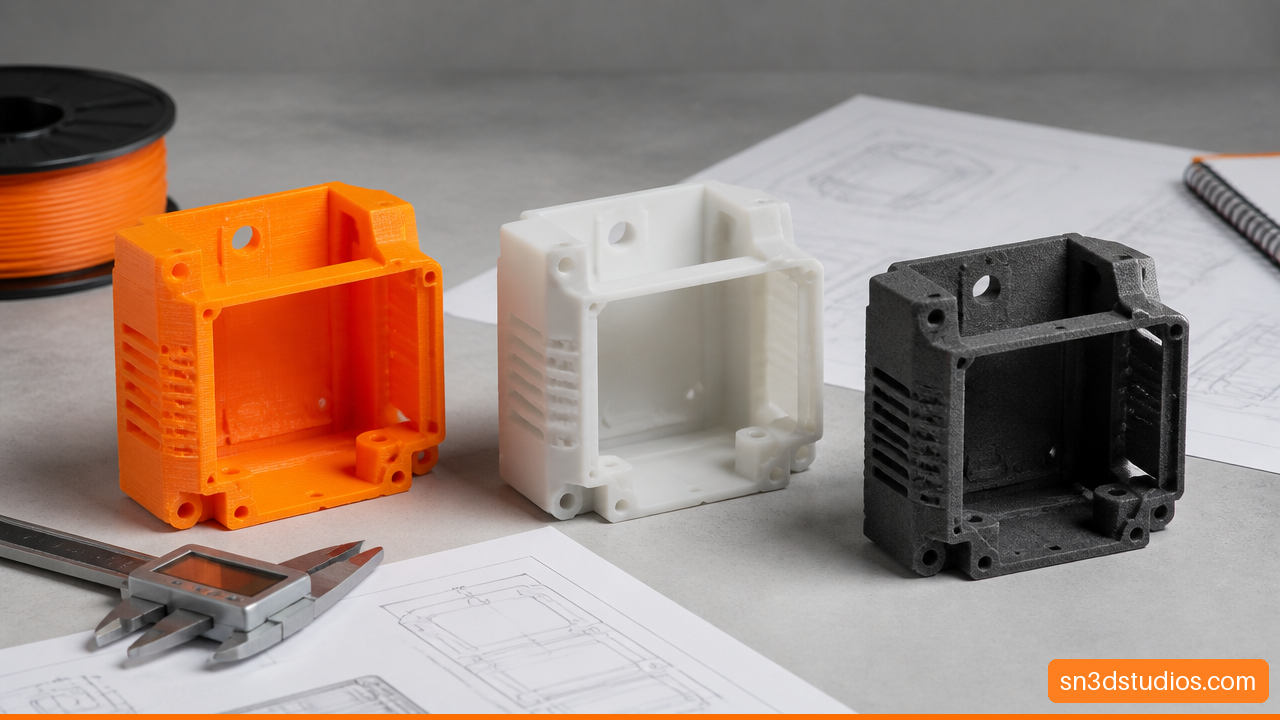
FDM, or Fused Deposition Modeling, builds a part by laying down thermoplastic layer by layer. It can be a practical choice when the goal is to check size, layout, or basic use without demanding a polished surface.
SLA, or Stereolithography, cures liquid resin and is often chosen for fine details and more refined presentation surfaces. Use it when small features matter, such as buttons, labels, miniature product models, or detailed housings. Avoid assuming it will behave like the final molded plastic. A great-looking resin part may not be the right part for a repeated impact test.
SLS fuses polymer powder, which can suit complex shapes without the conventional support structures used in FDM and SLA. It may be worth considering for interlocking parts, flexible clips, or internal channels where support removal would damage the feature.
Fair warning: a prototype can fail even when the CAD model is correct. Warping, shrinkage, support scars, weak layer direction, and resin brittleness can change what the physical part tells you.
Review Orientation And Failure Modes Before Printing
Build orientation affects more than looks. On an FDM part, a hook loaded across layer lines may split more easily than the same hook printed in another direction. On an SLA model, support contact points can affect visible surfaces. On any process, thick and thin areas can cool or cure differently.
I would ask the partner to identify these risks before production, especially when testing clips, hinges, sealing faces, thin walls, or threaded areas. If a product uses heat-set inserts, specify them early. Their size, location, and installation method can change wall thickness and hole design.
Decide Between A Direct Shop And A Network
Some services accept STL or STEP files and route jobs through partner manufacturing shops. OpenSpindle’s prototype and model service is an example of a model that may use manufacturing partners to match work with available capabilities.
A distributed network may offer broader access to processes or capacity. A direct specialist may provide faster feedback from the people preparing and producing the part. Neither model is automatically better.
Choose a direct relationship when frequent design discussion, inspection, or finish matching is central. Consider a network when the priority is comparing several process options or reaching capacity across locations. In either case, ask who owns quality checks and who communicates when a print does not meet the brief.
Control Cost, Quality, And Confidentiality
The quoted print price is only one part of prototype cost. A more complete view includes design changes, post-processing, shipping, failed tests, and the time spent waiting for answers.
Compare Total Cost, Not Just Unit Price
For many startups, outsourced printing can avoid purchasing and maintaining industrial equipment. HP’s overview of on-demand 3D printing notes that pay-per-use services can provide access to industrial capacity without an equivalent upfront equipment investment.
That does not mean outsourcing is always cheaper. If a team needs many quick, rough iterations, an in-house desktop printer may still be useful. External production can make more sense when the part needs specialized materials, larger build volume, high detail, finishing, or reliable documentation.
There is no universal prototype price or turnaround range. Geometry, material, size, finish, quantity, and queue time all matter. For instance, a simple unpainted fit-check part and a presentation model with sanding, coating, and assembly should not be budgeted as the same type of job.
Require Revision Control And Inspection
If a prototype will become a reference for later production, label every physical part with its CAD revision, material, process, orientation, finish, and date. This is prototype revision control. Without it, teams can accidentally compare a new test result with an older version built in a different material.
For critical dimensions, request a dimensional inspection report or agree on exactly what will be measured. Do not ask only, “Is it accurate?” Ask which features will be checked and against which drawing or CAD revision. This is especially useful for interfaces such as lids, mating housings, mounts, or assembly jigs.
Protect Unreleased Product Geometry
Before sharing files, ask how the provider manages confidentiality and intellectual property. The basic questions are practical:
• Who can access the files and production notes?
• Is a non-disclosure agreement available when needed?
• How long are files retained after the project ends?
• Can the startup request file deletion?
• Who owns modified CAD files if design help is provided?
Written answers are better than assumptions. This matters most for unreleased consumer products, patented mechanisms, medical-related concepts, and designs that could be copied easily from geometry alone.
Key Takeaways
• Choose a startup 3D printing partner based on the decision the prototype must support, not on printer type alone.
• Use different print plans for appearance models, fit-check parts, functional tests, and pilot units.
• Send a clear brief with CAD revision, critical dimensions, intended use, material needs, finish, and deadline.
• Evaluate total iteration cost, including redesigns, finishing, shipping, and time lost to unclear feedback.
• Ask about file access, revision control, inspection, and the route from printed prototype to low-volume production.
Frequently Asked Questions
What Does A Startup 3D Printing Partner Provide Beyond Printing?
A strong partner may provide CAD review, design-for-manufacturability guidance, process selection, material advice, finishing, assembly support, inspection, and planning for later production. The value is highest when the project has technical risks that a simple upload-and-print workflow will not catch.
Which Process Is Best For A Product Prototype?
Choose based on the test. FDM is often suitable for economical concept and fit-check parts. SLA can suit detailed appearance models. SLS may fit complex and durable polymer designs. If the part must behave like a final metal or molded component, ask whether CNC machining or another production process should be part of the plan.
Should I Send An STL Or A STEP File?
Send STEP when available, plus STL if the print workflow needs it. STEP can make it easier to review solid geometry and edit the model. STL may be sufficient for a stable, print-ready design, but it provides less design information.
How Can I Check Prototype Accuracy And Repeatability?
Identify the few dimensions that truly affect assembly or function. Give the partner a drawing or annotated CAD view, request measurement of those features, and record the part revision, material, process, and orientation. Repeatability is harder to judge from one part, so use consistent documentation across later orders.
Can One Partner Support Prototypes And Small Production Runs?
Some can. 3Dnatives’ overview of 3D printing service providers notes that some platforms combine online uploads, material and finish choices, quoting, shipping, and production support. Ask early whether the same provider can maintain revision control, material consistency, and inspection as quantities increase.
Sources And References
- Fresh Consulting — Rapid Prototyping Services: https://www.freshconsulting.com/services/hardware/rapid-prototyping/
- 3DRM Tech — Rapid Prototyping for Startups & Hardware Entrepreneurs: https://3drmtech.com/industries/startups-hardware-entrepreneurs/
- OpenSpindle — 3D Printing in Chicago, IL: Prototypes & Models: https://openspindle.com/capabilities/3d-printing/chicago-il
- HP — How 3D Printing Helps Small and Midsized Businesses: https://www.hp.com/us-en/tech-takes/3d-printing/worth-it/could-3d-printers-be-your-next-secret-weapon.html
- 3Dnatives — The Top 3D Printing Service Providers: https://www.3dnatives.com/en/best-3d-printing-services-in-the-us-260820194/