
Outsourced 3D Printing for Business Product Requirements
Outsourced 3D printing for business product requirements works best when a business treats the order as a controlled manufacturing project, not just a print request. I recommend defining what the part must do, how it will be checked, and what happens if it fails before comparing prices.
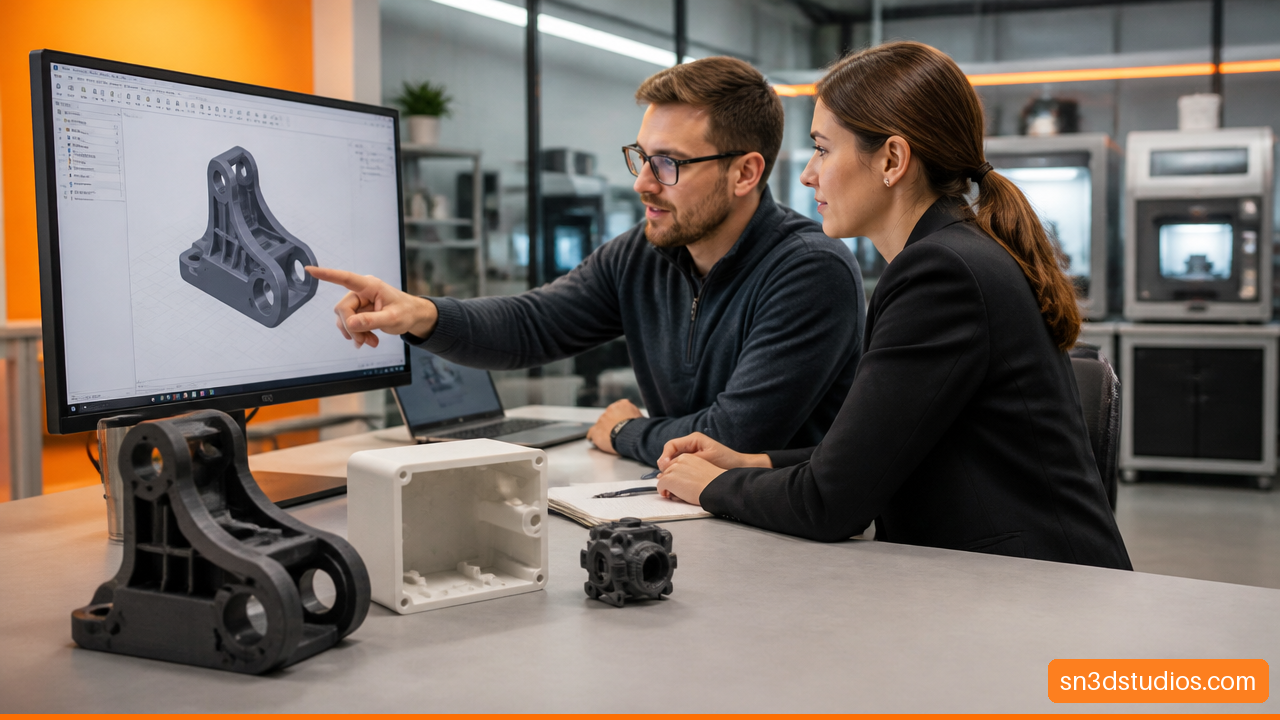
Table Of Contents
• Key Takeaways
• Choose Outsourcing Or In House Printing
• Turn Product Needs Into A Supplier Ready Specification
• Control Quality, Cost, And Supplier Changes
• FAQ
Key Takeaways
• Outsource when you need specialized materials, larger build capacity, complex geometry, finishing, or limited quantities that do not justify owning equipment.
• Use in house printing for frequent, simple concept checks where speed matters more than final material performance or formal inspection.
• A good request includes CAD files, quantity, material, finish, critical dimensions, inspection method, delivery date, and acceptance criteria.
• Do not compare quote totals alone. Compare total delivered cost, including engineering review, finishing, inspection, packaging, freight, and remake risk.
• Qualify a supplier in stages: sample part, pilot batch, then repeat production. A prototype that looks correct is not automatically qualified for end use.
A printed part can meet its overall shape while still failing at the one hole, snap feature, sealing face, or mating surface that matters most.
Choose Outsourcing Or In House Printing
Start With The Part, Not The Printer
The best choice depends on the product requirement. Protolabs identifies quality, quantity, speed, accuracy, materials, expertise, and production capacity as core outsourcing factors. That is a useful starting point, but each factor should be tied to a real product need.
For example, a design team may print a rough enclosure in house several times a day to check button placement. That is a good use of an internal printer. But if the next build must survive handling, fit a purchased gasket, and arrive with a consistent cosmetic finish, an external service bureau may be the better fit.
| Decision Factor | Outsourcing Is Usually Stronger When | In House Printing May Be Better When |
|---|---|---|
| Quantity | You need a one time batch or changing order sizes | You print similar simple parts often |
| Technology | You need SLS, resin, metal, or specialized finishing | A basic material extrusion process is sufficient |
| Quality Control | Critical dimensions need documented checks | Visual concept review is enough |
| Team Capacity | Engineers need to focus on design work | Staff already have print skills and spare capacity |
| Deadline | A provider can reserve the right process and finish route | Same day iteration matters more than final quality |
UltiMaker notes that outsourcing can suit low quantities, complex or large parts, unusual materials, and specialized final parts. Still, outsourcing is not automatically faster. Shipping, queue time, finishing, and approval cycles can add time. Ask for the full timeline from file approval to delivery, not only the machine print time.
Match The Process To The Job
Different additive manufacturing processes create different tradeoffs. FDM or FFF can be practical for fixtures, brackets, and early prototypes. SLA resin printing can provide fine detail and smooth surfaces, but material behavior and post curing should be reviewed for functional use. SLS can be useful for durable polymer parts and complex shapes because it does not rely on conventional support structures. Metal additive manufacturing may fit demanding metal applications, though its cost, qualification needs, and post processing are usually more involved.
I would avoid selecting a process from surface appearance alone. Build orientation can affect strength, supports, visible surfaces, and accuracy. Layered parts may be anisotropic, meaning their mechanical behavior can vary by direction. A clip that works when loaded along one direction may crack when loaded across layers.
Turn Product Needs Into A Supplier Ready Specification
Define The Functional Requirement First
A supplier cannot reliably choose a material from a vague note such as “strong plastic.” State what the part must do. Is it a display model, a fit check, a load bearing bracket, a heat exposed cover, or a customer facing product shell?
3D Systems explains that functional prototypes can help evaluate appearance, function, mechanical characteristics, weight, assembly, and manufacturability. Those are separate tests. A part used to confirm appearance needs a different validation plan from a part used to confirm repeated mechanical movement.
Use a requirements package with the following information:
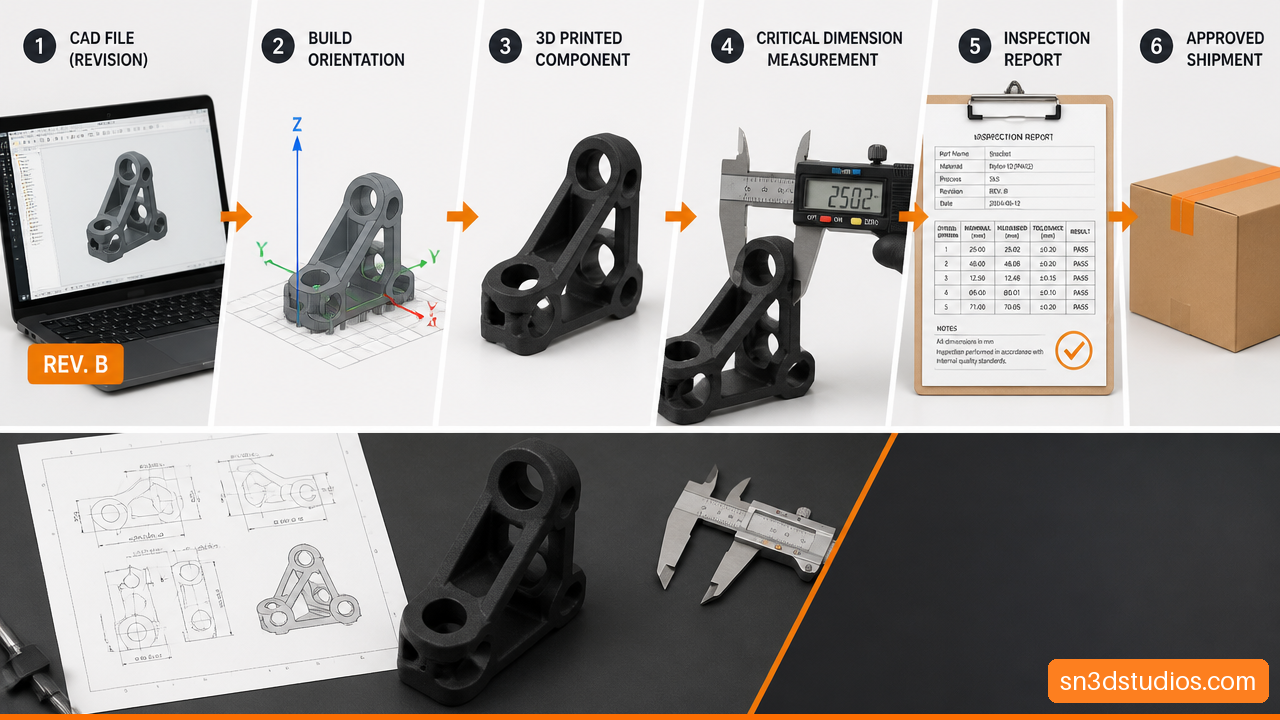
- Released CAD file: Provide the current STEP, native CAD, or STL file as requested. Identify the revision number and design freeze date.
- Part purpose: Explain whether the part is for appearance, fit, assembly, functional testing, tooling, or sale.
- Material and finish: Name the required material if known. If not, state operating conditions such as impact, heat, moisture, UV exposure, or chemical contact.
- Critical features: Mark dimensions that control fit, sealing, motion, or safety. Include a drawing where possible.
- Quantity and delivery: State prototype, pilot, or repeat production quantity, plus the required delivery date.
- Inspection and records: Specify which dimensions need measurement, what report is required, and whether material or batch documentation is needed.
Make Acceptance Criteria Measurable
“High quality” is not an acceptance criterion. Instead, define the nominal dimension, allowed variation, datum reference, measurement method, and pass or fail rule.
Consider a housing with four screw bosses. The outer shape may be noncritical, while the boss spacing determines whether the assembly closes. The drawing should identify those bosses as critical, state the acceptable variation, and clarify whether calipers, a gauge, or a coordinate measuring machine will be used. Without this detail, a supplier may inspect different features than the buyer expects.
Post processing also deserves attention. Support removal, sanding, curing, dyeing, machining, coating, and heat treatment can change surface texture or dimensions. Leave finishing allowance on surfaces that will be machined or coated. Ask the supplier to confirm whether inspection occurs before or after finishing.
Protect Files And Control Revisions
Before uploading CAD files, agree on confidentiality terms and access controls. For sensitive products, ask who can access the files, whether subcontractors are involved, how long files are retained, and how deletion is confirmed after the project closes. If export controls or industry rules apply, obtain appropriate legal and compliance guidance.
A revision control rule is equally important. The quote, build file, drawing, and purchase order should point to the same revision. A late file replacement can create an expensive mismatch between the approved design and the printed part.
Control Quality, Cost, And Supplier Changes
Compare Evidence, Not Just Process Lists
A provider may list many printer types, but the stronger question is whether it can prove capability for your part. Gartner Peer Insights describes service bureaus as providers of concept models, prototypes, spare parts, and finished goods that may also offer engineering, post processing, assembly, and quality assurance. The actual scope varies by provider and project.
I recommend asking for evidence that matches the requirement:
• Similar material and process examples
• A sample inspection report for comparable critical features
• Clear finishing options and expected surface condition
• Material identification or certificates when the application needs them
• A written nonconformance process for rejected parts
• Change notification if the machine, material lot, orientation, finishing route, or subcontractor changes
A supplier substitution should be treated as a product risk event. A new machine model or finishing route may affect dimensions, texture, and performance. For cosmetic prototypes, a visual approval may be enough. For a functional assembly part, a new sample or pilot batch may be prudent.
Calculate Total Delivered Cost
The lowest print price can become the highest project cost if it omits necessary work. 3DPrint UK advises that outsourcing comparisons should include ownership costs, post processing, lead times, IP protection, and delivery control. The same principle applies when comparing two external quotes.
| Cost Element | Why It Matters |
|---|---|
| Engineering Review | May prevent a failed build or poor orientation choice |
| Setup And Supports | Can affect price, surface quality, and schedule |
| Post Processing | Often determines final appearance and usable dimensions |
| Inspection | Adds confidence for critical features but may add cost |
| Packaging And Freight | Can affect delivery date and damage risk |
| Expedited Service | Can be costly if design approval is delayed |
| Remake Exposure | Matters when a failed part stops an assembly build |
Use A Staged Qualification Plan
When requirements are uncertain, avoid jumping from a CAD model to a large order. A staged plan reduces risk:
- Order a sample part to check appearance, fit, and basic handling.
- Run a small pilot batch to test repeatability, assembly, and inspection reporting.
- Approve a controlled production route for repeat orders.
This approach is especially useful for parts with snap fits, threaded inserts, mating faces, or cosmetic finishes. It also gives both sides a clear record of the approved material, orientation, finishing route, and inspection plan.
FAQ
When Should A Business Outsource 3D Printing Instead Of Buying A Printer?
Outsource when the work is occasional, needs specialized technology, requires professional finishing, or needs documented quality checks. Buy or operate in house when simple parts are printed frequently and staff can manage maintenance, calibration, materials, and workflow.
What Information Does A 3D Printing Service Need To Quote A Part?
Provide the CAD file, revision number, quantity, intended use, preferred material, finish, critical dimensions, inspection needs, delivery location, and required date. Add photos or drawings when appearance or assembly details are hard to show in the CAD model.
Which Process Is Best For Functional Business Parts?
There is no universal best process. Choose based on loads, temperature, chemical exposure, geometry, required finish, and quantity. Request a supplier review when a part has moving features, thin walls, snap fits, sealing surfaces, or safety related use.
Can A Prototype Use The Same Material And Process As The Final Part?
Yes, but only if the prototype is intended to test the same properties. A visual prototype may use a lower cost process, while a production qualification part should use the intended material, orientation, finish, and post processing route whenever practical.
How Should Critical Dimensions And Inspection Requirements Be Specified?
Use a controlled drawing that identifies critical dimensions, datums, allowed variation, measurement method, and acceptance rule. Also state whether every part or a sample of parts must be inspected, and what documentation must be delivered with the order.
Sources/References
• Protolabs + “When to Outsource 3D Printing Production” — https://www.protolabs.com/resources/blog/when-to-outsource-3d-printing-production/
• UltiMaker + “3D printing – Outsource, or print in-house?” — https://ultimaker.com/learn/3d-printing-outsource-or-print-in-house/
• 3D Systems + “3D Printing for Service Bureaus” — https://www.3dsystems.com/service-bureaus
• Gartner Peer Insights + “Best 3D Print Service Bureaus Reviews 2025” — https://www.gartner.com/reviews/market/3d-print-service-bureaus
• 3DPrint-UK + “In-House vs Outsourced 3D Printing Service” — https://www.3dprint-uk.co.uk/in-house-versus-outsourced-3d-printing-service-part1/