
3D Printing Services in Vizag for Custom Parts and Prototypes
3D printing services in Vizag for custom parts and prototypes can help turn a CAD file, sketch, reference image, or damaged component into a physical object without committing to expensive tooling. I would treat the service as a design and verification process, not simply a print order. The best result depends on what the part must do after it leaves the printer.
Table Of Contents
• Key Takeaways
• Choose The Right Process And Material
• Prepare A Clear Quote And Design Brief
• Verify Quality Before Ordering More Parts
• Frequently Asked Questions
• Sources And References
Key Takeaways
• Use FDM for many larger, practical, and lower cost prototypes. Choose resin printing when fine surface detail and small features matter most.
• Separate a visual model from a functional prototype. A display enclosure and a clip that opens every day need different materials, orientations, and testing.
• Send dimensions, quantity, material needs, finish expectations, deadline, and intended use together. An STL file alone rarely provides enough detail for a comparable quote.
• For replacement parts and assemblies, request a fit check before ordering the final quantity.
• Treat claims such as “high precision” or “fast turnaround” as starting points for questions. Ask for the achievable tolerance, build volume, finish options, and current material availability for your part.
Choose The Right Process And Material
Start With The Part’s Job
The first question is simple: is the object meant to look right, fit with another object, or carry out a real task? That answer controls nearly every other choice.
A visual prototype may be used to review shape, color, branding, or scale. A functional prototype may need to hold a screw, protect electronics, slide into a housing, resist a small impact, or survive repeated assembly. The second type needs more planning because 3D printed strength changes with wall thickness, infill, print direction, and material.
For example, a small electronics enclosure can look excellent in a basic material but still crack near a screw boss if the walls are too thin. A better request would specify the device weight, screw type, mounting method, indoor or outdoor use, and whether the lid will be opened repeatedly.
Local providers advertise a wide range of work. Vizag 3D Prints lists prototypes, custom gadgets, functional parts, architectural models, and PLA, ABS, and resin printing in Visakhapatnam. Availability, however, is not the same as proof that a material is right for a demanding application.
Match FDM Or Resin To The Requirement
| Need | Usually A Better Starting Point | Why | Watch For |
|---|---|---|---|
| Large enclosure or basic fixture | FDM | Often practical for larger shapes and functional iterations | Visible layers and weaker direction between layers |
| Miniature, figurine, or detailed display model | Resin | Fine details and smoother surfaces are possible | Resin choice may not suit impact or long term outdoor use |
| Early size and shape check | FDM with PLA | Often economical for quick geometry review | Low temperature limits for the finished use |
| Tougher functional concept | ABS, nylon, or another suitable engineering material | May better match heat, impact, or wear needs | Design and process conditions still matter |
FDM, or Fused Deposition Modeling, builds a part by placing melted thermoplastic filament in layers. Its layer direction matters. A hook printed flat may fail along layers differently from the same hook printed on its side. Resin printing cures liquid resin layer by layer and can create finer detail, but “resin” is a category, not a single performance promise.
I would avoid selecting PLA, ABS, nylon, or resin by name alone. Describe the use condition instead: heat near a motor, rain exposure, load on a bracket, repeated snapping, or contact with a mating part. Local provider pages do not publish independent performance data for every material and print setting, so a use based discussion is more useful than a generic material list.
Design For A Successful Print
A CAD model can be correct on screen yet difficult to print. Thin walls may warp or break. Deep overhangs may need support structures that leave marks after removal. Holes often need allowance for final fit, and threads may be better added after printing with a tap or threaded insert.
For moving or mating parts, include clearance from the start. A lid that must slide over a box needs space for both print variation and surface texture. If the fit is critical, print only the joint, hole pattern, or snap feature first. That small test can prevent an entire batch from becoming scrap.
Prepare A Clear Quote And Design Brief
Send More Than A File
Many Vizag services can work from an existing 3D file or help prepare a model from requirements. SN 3D Studios describes a workflow that begins with requirements or files, then moves through model preparation, print planning, production, and refinement. This staged approach is useful because a printable file still needs manufacturing choices.
For an accurate quotation, I would send this information in one written message:
- Part purpose: visual sample, fit test, functional part, replacement component, or small batch product.
- File or reference: STL for printing, STEP for editable engineering geometry, or a sketch, photos, and measurements when no model exists.
- Dimensions and quantity: overall size, number of pieces, and any critical dimensions.
- Material needs: heat, impact, flexibility, outdoor exposure, electrical enclosure use, or appearance needs.
- Fit requirements: mating surfaces, screw sizes, shaft diameter, thread needs, and permitted clearance.
- Finish and deadline: support removal, sanding, painting, curing, assembly, pickup, or courier delivery.
This makes it easier to compare quotations fairly. One supplier may quote a low price for a basic PLA print, while another may include model repair, stronger walls, support cleanup, and a better material. Those are not equivalent orders.
Reproducing A Missing Or Broken Part
A replacement part without CAD data needs careful measurement and verification. A community discussion in Visakhapatnam mentions duplication of existing parts and a provider advertising FDM work for enclosures, technical models, and reproductions; see the local part reproduction discussion. The claim is provider reported, and the thread does not document final accuracy.
A safer process is to measure the original part, identify the surfaces that touch other components, and test a low cost sample before ordering the final version. Consider a knob with a central shaft hole: the outside shape can look correct while a hole that is slightly too small makes it unusable. Requesting a sample with only the critical hole and mating face can reduce risk.
Verify Quality Before Ordering More Parts
Ask Questions That Produce Measurable Answers
Published local pages do not provide a consistent comparison of tolerance, machine calibration, build volume, minimum order quantity, or post processing. That does not mean a provider cannot meet a need. It means I would ask directly rather than assume.
Useful questions include:
• What tolerance can you reasonably target for this material and size?
• What is the maximum build volume, and must the model be split?
• Which material and orientation do you recommend for the load direction?
• Will supports touch visible or mating surfaces?
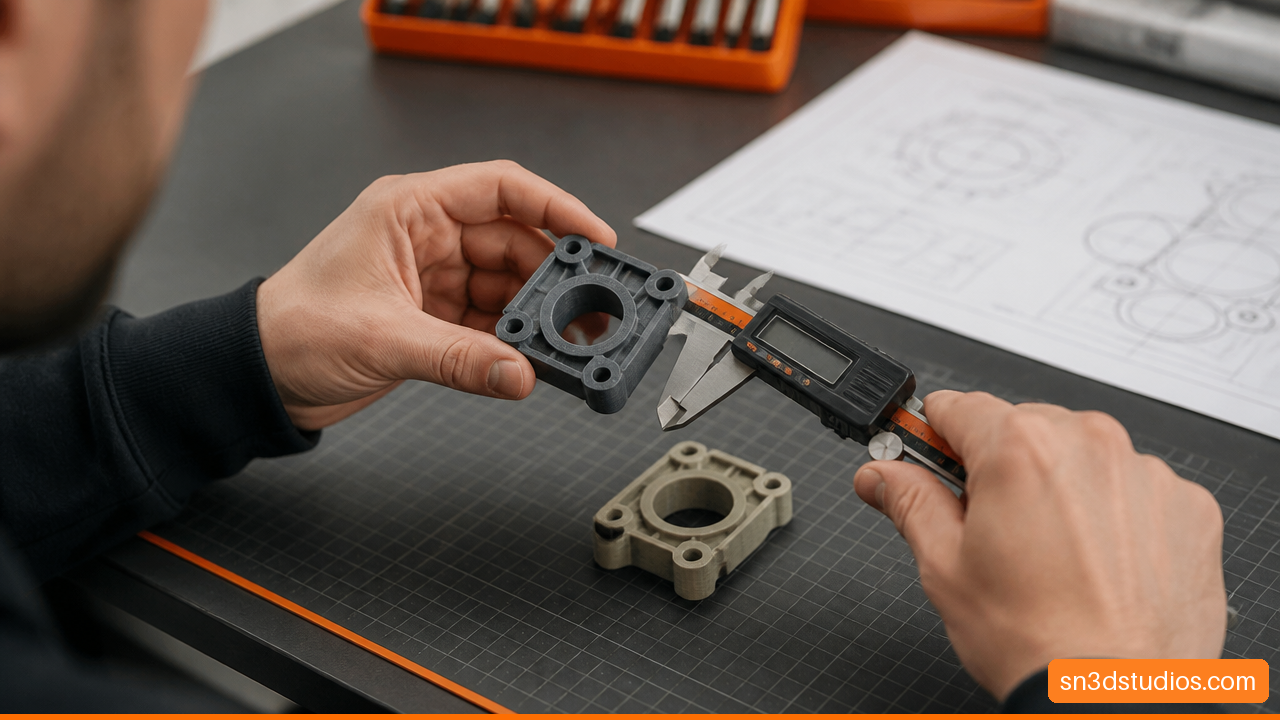
• Can you provide a fit check or test feature before the final quantity?
• What finishing steps are included in the quote?
Use Local Pickup When Inspection Matters
Local pickup can be useful for a precision prototype because it allows a quick inspection before the part travels. Check the dimensions, support marks, screw holes, warping, and mating surfaces while the order can still be discussed. Courier delivery may be more convenient for a simple decorative model or repeat order, but delicate parts should be packaged to protect thin features.
Community comments have recommended local services for prototyping and mentioned possible Vizag locations, but those details may change. The community recommendations for Vizag service locations and outsourcing should therefore be verified directly before visiting.
Make The First Print A Learning Step
For a one off display piece, a single final print may be reasonable. For a replacement component, enclosure, snap fit, or multi part assembly, a sample stage is usually safer. Check the fit, revise the CAD model if needed, then approve the final quantity.
This is especially important when the part must handle heat, repeated stress, or outdoor conditions. Without material specific test data for the planned print settings, a small real use trial provides more useful information than a broad claim that a material is “strong.”
Frequently Asked Questions
Can A Vizag 3D Printing Service Print From STL, STEP, Or SolidWorks Files?
Usually, STL files are suitable for direct printing, while STEP files are often more useful when dimensions or features need editing. Native SolidWorks files may require confirmation from the provider. Include a PDF drawing or written list of critical dimensions so the intended result is clear.
Can A Service Create A Model From A Sketch Or Existing Part?
Yes, many services offer design support or model refinement. Provide clear photos from multiple angles, measurements, the part’s purpose, and close ups of mating features. For a broken part, retain every fragment if possible because small details can affect the final fit.
How Much Does A Custom 3D Print Cost In Visakhapatnam?
There is no reliable public rate that applies to every job. Cost changes with model volume, material, print time, supports, layer height, finishing, design work, quantity, and delivery. Ask multiple providers to quote the same brief and confirm what each quote includes.
Which Is Better For My Prototype: FDM Or Resin Printing?
Choose FDM when you need a practical early prototype, larger object, or a part where material behavior matters more than very fine surface detail. Choose resin for small detailed models, miniatures, and appearance focused work. For a functional component, confirm the specific resin or filament is suitable for its real use.
Can I Order Just One Replacement Part?
Often, yes, but availability and minimum charges vary. For a part with a critical fit, order one sample first. Measure it against the mating component, test movement and fastening, then approve any additional pieces.
Sources And References
• Reddit — 3D Printing Services, r/Visakhapatnam: https://www.reddit.com/r/Visakhapatnam/comments/1jdz9hm/3d_printing_services/
• Vizag 3D Prints — Vizag 3D Prints: https://vizag3dprints.carrd.co/
• SN 3D Studios — Custom 3D Printing & Design: https://sn3dstudios.com/
• Reddit — Avarayina vizag lo 3D printing machine konnaraa?, r/Visakhapatnam: https://www.reddit.com/r/Visakhapatnam/comments/1p0wq9d/avarayina_vizag_lo_3d_printing/