On Demand Custom 3D Printed Components for Engineers
On demand custom 3D printed components for engineers make it possible to turn a CAD model into a physical part without waiting for molds, castings, or long machining queues. I recommend treating additive manufacturing as an engineering decision, not just a quick print service. The right process depends on load, heat, fit, finish, quantity, and how the part will be tested.
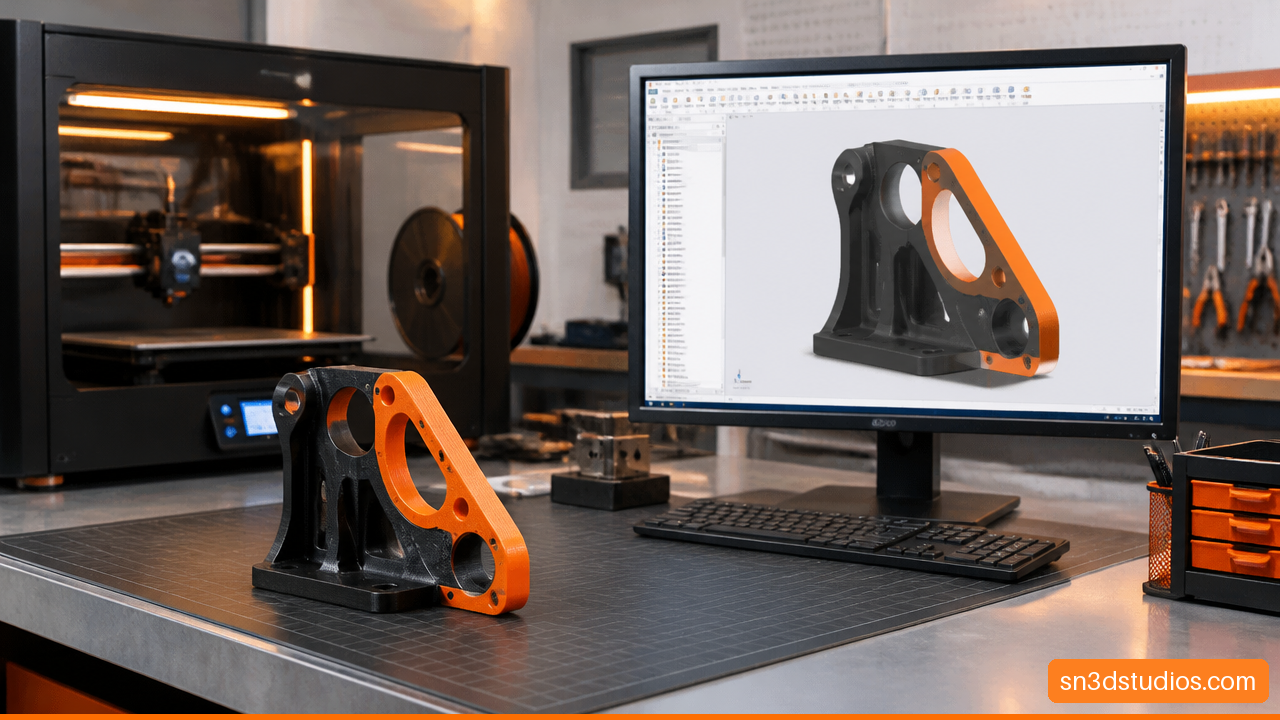
Table of Contents
- Choose A Process Based On Part Requirements
- Design Parts For Printability And Verification
- Key Takeaways
- Frequently Asked Questions
- Sources
Choose A Process Based On Part Requirements
Start With The Part’s Job
The best printing method is the one that meets the part’s real job. Before requesting a quote, define whether the component is for visual review, fit testing, functional testing, production use, or factory tooling.
A phone mount prototype and a machine bracket may look similar in CAD, but they need very different decisions. The phone mount may prioritize appearance and surface quality. The bracket may need stiffness, fatigue resistance, threaded inserts, and controlled dimensions at mounting holes.
Online services can produce custom plastic, metal, and elastomeric components for both prototypes and production work through different additive processes. Protolabs describes this range of custom plastic, metal, and elastomeric printing options. Still, material labels alone do not prove that a part is fit for a specific load or environment.
| Engineering Need | Often Worth Considering | When To Be Careful |
|---|---|---|
| Fast fit check or enclosure | FDM or SLA | Avoid assuming an appearance model proves structural strength |
| Complex functional plastic part | SLS or MJF | Confirm mating dimensions and final surface needs |
| Fine detail or smooth visual surface | SLA or PolyJet | Check long term heat, UV, and mechanical requirements |
| Flexible grip, seal, or soft interface | Elastomeric materials | Validate compression set and chemical exposure |
| Heat resistant metal component | Metal additive manufacturing or machining | Compare cost, finish, and post processing needs |
| Sand core or forming tool | Binder jetting | Confirm tooling requirements with the production process |
Use A Practical Selection Matrix
I suggest ranking requirements before choosing a process. Give the highest priority to the condition that would cause failure first.
- Load direction: Is the part pulled, bent, compressed, or repeatedly cycled?
- Temperature: What is the highest expected operating temperature, not just room temperature?
- Environment: Will it face oils, cleaners, moisture, UV exposure, or chemicals?
- Critical fit: Which holes, sealing faces, or press fits must meet a defined requirement?
- Quantity: Is this one emergency replacement part, a batch of 20 fixtures, or a repeat order?
- Finish and assembly: Does the component need machining, coating, tapped holes, inserts, or leak sealing?
For industrial tooling, printed parts are not limited to final products. ExOne notes that binder jetting can produce sandcasting cores and forming tools. That matters when the printed component supports another manufacturing step rather than becoming the finished item.
Know When Printing Is Not The Best Choice
3D printing is often attractive when the quantity is low, the shape is complex, or avoiding hard tooling matters. It can be less attractive when a large part needs tight tolerances on many faces, a very smooth finish, or high volumes that justify injection molding.
For example, a one piece fixture with curved cable paths and built in locating features may be a strong additive candidate. A simple flat aluminum plate with a few precise holes may be faster and less costly to machine. The key is not asking, “Can this be printed?” Ask, “What production route creates the lowest risk for this part?”
Design Parts For Printability And Verification
Orientation Is A Performance Decision
Build orientation affects more than appearance. Because additive manufacturing builds in layers, some printed parts can behave differently depending on the direction of force. This is called anisotropy.
If a clip is loaded across weak layer bonds, it may crack sooner than the same clip printed in a different orientation. Orientation can also affect warpage, support marks, surface finish, dimensional accuracy, and the shape of circular holes.
A part can look correct on the build plate and still fail in service if its load path, layer direction, and post processing plan were not considered together.
That is why a quote should be followed by a manufacturability discussion when the part is functional. Stratasys Direct explains that upload and quote workflows can move into expert review, machine scheduling, and production planning. A fast quote is useful, but it is not the same as a confirmed delivery date or a validated manufacturing plan.
Specify What Must Be Controlled
A CAD model rarely tells a supplier everything needed for an engineering component. Include a drawing or written specification when dimensions, finishes, or inspection needs matter.
Useful details include:
• Critical dimensions and their allowable variation
• Thread type, insert type, or tapping requirements
• Mating part information for holes, slots, clips, and press fits
• Surface finish expectations for visible faces, seals, or sliding surfaces
• Material restrictions for heat, impact, chemicals, outdoor use, or electrical needs
• Inspection requirements, including measured dimensions and acceptance criteria
If a complete CAD model is not available, the project can still begin with incomplete inputs. ALT LLC describes workflows that can start with CAD, dimensions, photos, sketches, or a functional description before engineering review. For a replacement part, however, reverse engineering should include a fit check. A worn original may not represent its original dimensions, and a copied shape may not be safe for a load bearing or regulated use.
Treat Post Processing As Part Of The Design
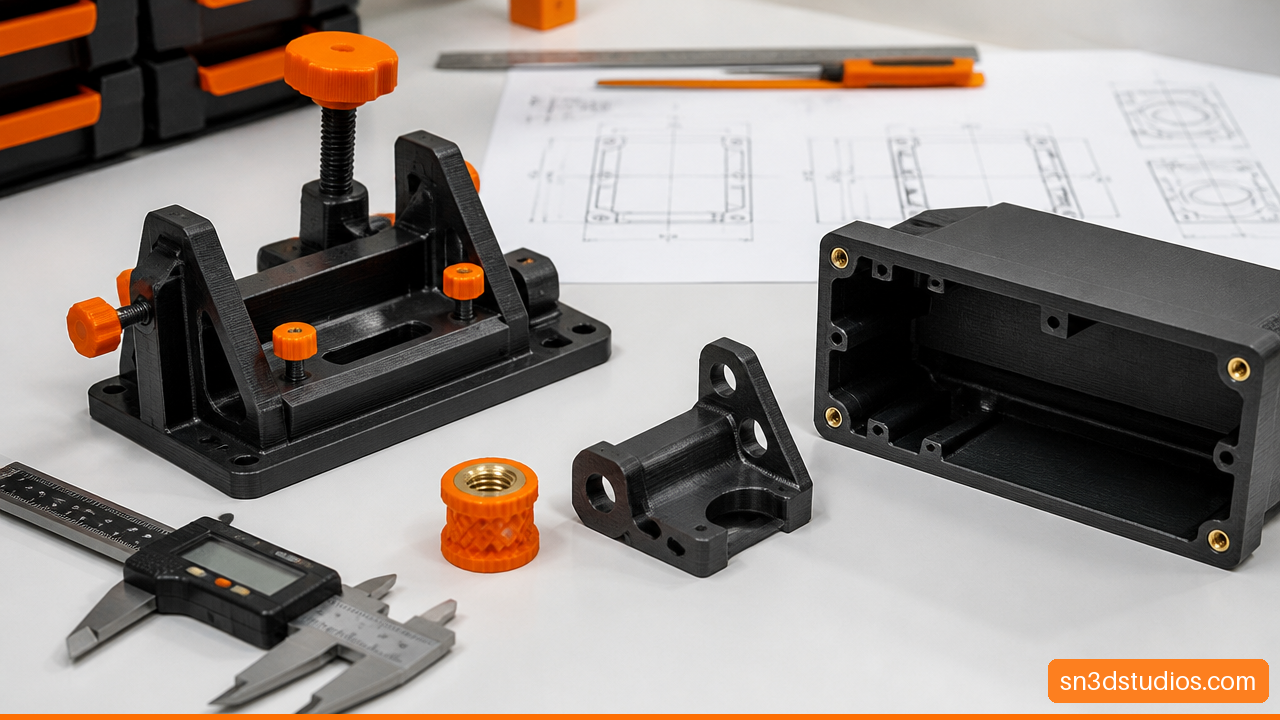
A printed component may need more work before it is ready for use. Common post processing steps include machining, sanding, smoothing, coating, heat treatment, tapping, inserting threaded hardware, and inspection.
These steps affect cost and lead time. Consider a printed housing with a gasket groove and threaded mounting points. Printing may create the main shape quickly, but the sealing face may need machining and the mounting points may need metal inserts. If those steps are ignored during quoting, the final part can arrive later than expected or fail to assemble correctly.
On demand workflows may offer Design for Additive Manufacturing support, post processing, and validation options rather than one fixed print setting. Stratasys Direct outlines on demand services that may include engineering support, multiple technologies, finishing, and verification or validation options. For controlled production, ask whether first article inspection or PPAP related documentation is available when your supply chain requires it.
Key Takeaways
• Choose the process based on load, heat, environment, fit, quantity, and finish rather than speed alone.
• Treat build orientation as a design variable because it can affect strength, surface quality, warpage, and dimensional behavior.
• Separate quote speed from finished part lead time. Material, quantity, finishing, inspection, and shipping can all add time.
• Request drawings, critical dimensions, and acceptance criteria for functional components.
• Validate replacement parts and end use components through fit checks and appropriate testing. A successful prototype does not automatically qualify a production part.
• Include post processing in the first quote, especially for threads, inserts, seals, machined surfaces, and controlled dimensions.
Frequently Asked Questions
What Does On Demand Custom 3D Printing Mean For Engineering Components?
It means a component is produced when needed from digital design information rather than from pre made molds or large production tooling. It is useful for prototypes, jigs, fixtures, replacement parts, and lower quantity production runs. The service may include design review, print preparation, production, finishing, and inspection.
Which 3D Printing Process Is Best For A Functional Engineering Part?
There is no universal best process. FDM can suit many fixtures and enclosures. SLS and MJF can be useful for complex functional polymer parts. SLA and PolyJet are often chosen for detail and appearance. Metal processes may suit high temperature or high strength needs, but cost and finishing can be significant. Choose based on the part’s load, environment, fit, and testing plan.
Should A Prototype Use The Same Material And Process As The Final Part?
Use the same process and material when the test is meant to predict final performance. A visual prototype can use a faster or less costly option. A part being tested for fatigue, heat, chemical exposure, or sealing should be much closer to the intended production route. Otherwise, the test may only prove shape and assembly.
How Do I Specify Tolerances And Surface Finish?
Provide a drawing that marks critical features and explains the intended function. Identify sealing faces, press fits, threaded holes, mating surfaces, and cosmetic faces. Ask how the selected process, orientation, and post processing route will affect those features. For tight tolerances, machining after printing may be the practical solution.
What Lead Time Should I Expect After Receiving An Instant Quote?
An instant quote is usually an early pricing step, not a delivery promise. Some providers advertise production in as little as one day for selected orders, but the finished schedule depends on geometry, material, machine availability, finishing, inspection, quantity, and shipping. Confirm the delivery date after the manufacturing route is reviewed.
Sources
- ALT LLC — Product Customization & 3D Personalization: https://www.3dalt.com/product-customization
- Stratasys Direct — Fast, Custom 3D Printing Services Online: https://www.stratasys.com/en/stratasysdirect/services/3d-printing-services/
- Stratasys Direct — On Demand 3D Printing | Instant Quote: https://www.stratasys.com/en/stratasysdirect/
- ExOne — Parts & Services: https://www.exone.com/en-US/parts-and-services
- Protolabs — Online 3D Printing Service for Custom Parts: https://www.protolabs.com/services/3d-printing/