
Affordable Custom 3D Printed Parts for Startups in India
Affordable custom 3D printed parts for startups in India can reduce the cost of early product testing without requiring expensive molds or large production runs. I recommend treating 3D printing as a staged product-development tool: use low-cost parts to test fit and function first, then spend more only when the design is ready.
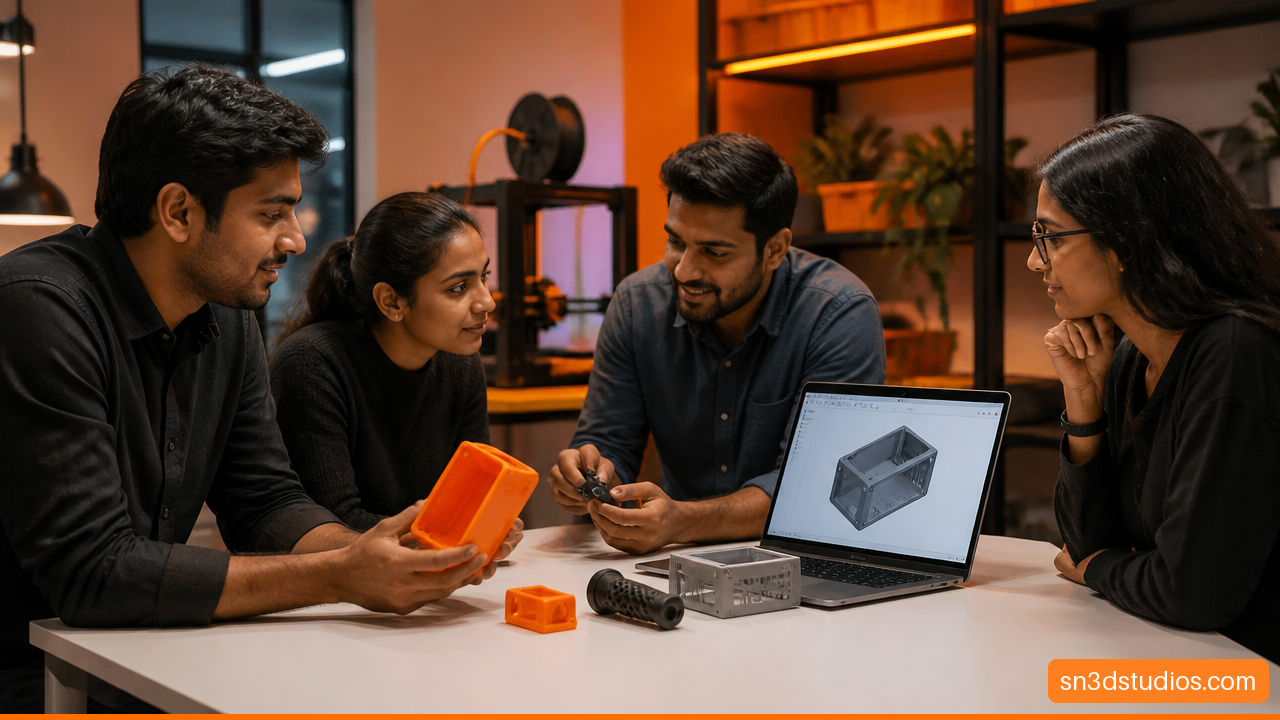
Table Of Contents
- Understand The Real Cost Of A Custom Part
- Choose The Right Process And Material
- Request Quotes That Are Easy To Compare
- Frequently Asked Questions
- Sources And References
Understand The Real Cost Of A Custom Part
The cheapest quoted print is not always the most affordable part. A startup should focus on landed cost: the full amount needed to receive a usable part for testing or sale.
A supplier may charge for printing by weight, volume, machine time, or per piece. Those pricing methods are not directly comparable. The same enclosure can cost more if it needs a detailed finish, careful support removal, dimensional inspection, or fast delivery.
Build A Simple Landed Cost Model
When I review a quote, I would separate the cost into clear parts. This makes unexpected charges easier to spot before production begins.
| Cost Element | What It Covers | Why It Matters To Startups |
|---|---|---|
| CAD design or repair | Creating, editing, or fixing a 3D model | A low print price can hide significant design work |
| Print production | Material, machine time, setup, and labor | Usually the headline price, but not the entire cost |
| Post-processing | Support removal, sanding, curing, painting, or machining | Can change both appearance and final dimensions |
| Inspection | Measuring critical dimensions or checking defects | Useful for parts that must fit another component |
| Packaging and shipping | Safe dispatch and delivery to your city | Important for fragile resin parts and urgent iterations |
| Taxes and reprints | GST or replacement parts after a failed test | Needed for a realistic prototype budget |
Partwork’s indicative India pricing guide shows why a single rate is rarely enough: its examples vary by process, material, size, machine time, labor, and finishing requirements. Treat such figures as planning inputs, not a national price list.
A useful example is a handheld device enclosure. The first print may only need to confirm whether a circuit board fits, so plain FDM plastic with a basic finish is often enough. A later sample for investor photos may need smoother resin printing, sanding, and paint. They are both “one enclosure,” but they answer different questions and should not have the same budget.
Where Startups Can Save Without Cutting The Wrong Corners
Affordable additive manufacturing depends on reducing unnecessary complexity, not simply choosing the lowest-cost material.
• Print a small test section before ordering a large enclosure with clips, threads, or snap fits.
• Use standard colors for early prototypes when color is not part of the test.
• Avoid ultra-fine layer heights unless surface appearance or tiny text truly matters.
• Combine several small parts in one order when delivery and setup costs are meaningful.
• Ask whether hollowing, lower infill, or a different orientation can reduce material use without weakening the test area.
• Keep the first functional prototype simple. Features such as logos, cosmetic textures, and paint can wait until the geometry works.
Fair warning: reducing infill does not always reduce cost safely. A mounting bracket may look solid but crack around a screw boss if the wall thickness and print orientation are wrong. For load-bearing parts, wall design and layer direction can matter more than infill percentage.
Choose The Right Process And Material
The best printing method changes as a product moves from a rough idea to a tested prototype. I would not use one process for every stage simply because it produced a good first sample.
Match The Process To The Question You Need Answered
| Need | Practical Starting Choice | When To Avoid It |
|---|---|---|
| Fit check, simple enclosure, basic fixture | FDM with PLA or another common filament | Avoid for high heat, very fine cosmetic detail, or demanding strength tests |
| Detailed visual model, miniature feature, polished presentation part | SLA or DLP resin printing | Avoid when the part needs repeated bending or impact resistance unless the resin is selected for that use |
| Stronger functional shape with complex geometry | Nylon-based SLS or MJF | Avoid for an early shape test if lower-cost FDM will answer the question |
| Flexible grip, seal, foot, or protective cover | TPU | Avoid where a rigid, precise snap-fit is required |
| Metal-like strength or heat performance beyond polymers | Metal additive manufacturing or another metal process | Avoid for ordinary MVP testing because cost and finishing needs can rise quickly |
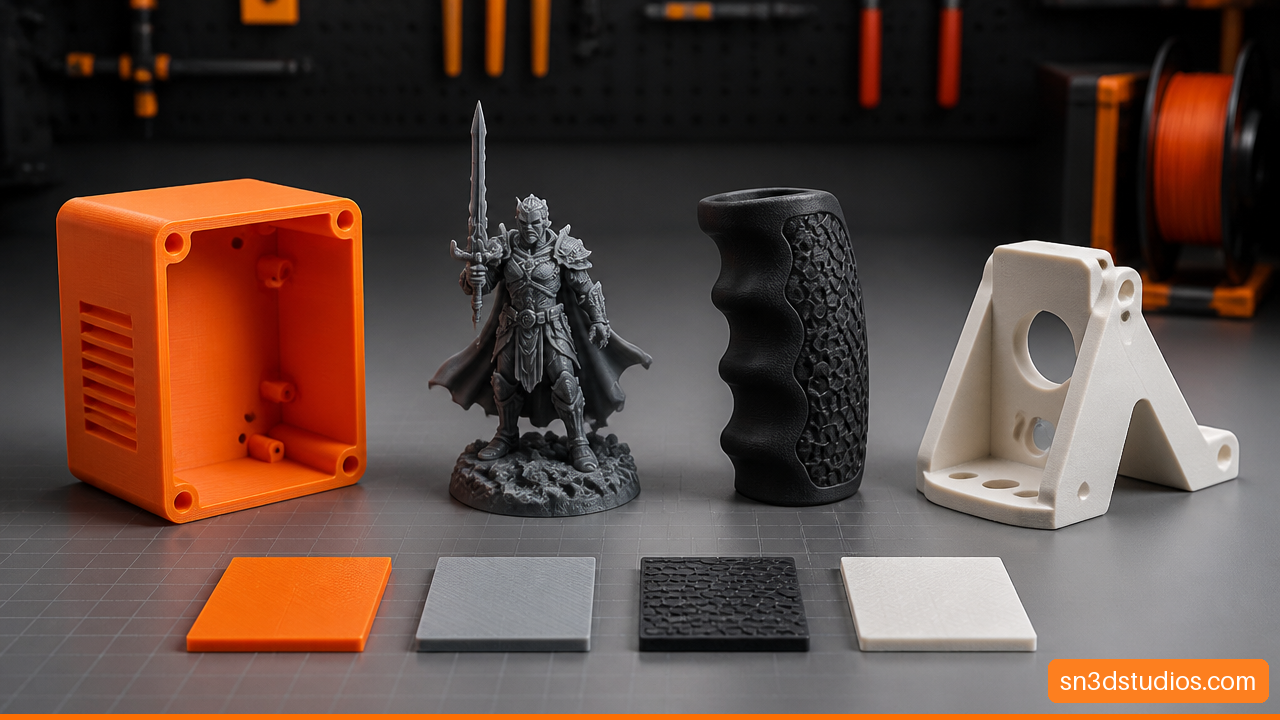
FDM builds parts by depositing thermoplastic filament layer by layer. It is often the most practical route for brackets, jigs, enclosures, and fit checks. Resin processes can produce sharper details and smoother surfaces, but the printed resin should be chosen with care if the part will flex or take impact.
A provider posting in India’s 3D-printing community describes FDM for stronger functional parts and resin for high-detail work, which is a helpful starting point rather than a universal rule. Its post also states a 2–3-day turnaround with dispatch from Indore within 24 hours after confirmation; see the provider’s stated turnaround and dispatch details. Delivery performance still depends on queue time, finishing, dispatch, and shipping destination.
Select Materials By Failure Risk
Material selection should begin with what could go wrong in the real product.
• Choose PLA for low-cost shape, size, and basic fit testing where heat and long-term outdoor exposure are not major concerns.
• Consider ABS or similar engineering filaments when improved toughness is needed, while accounting for possible warping and finish differences.
• Choose TPU for controlled flexibility, such as cable guards, grips, vibration feet, and protective sleeves.
• Consider nylon or PA materials for functional parts that need better toughness and more complex geometry.
Before ordering, write down the actual test: “must hold a 1 kg load,” “must not deform near a warm motor,” or “must fit around a 40 mm tube.” That statement is far more useful to a print partner than asking for the “strongest plastic.”
Request Quotes That Are Easy To Compare
A good quote request is a short engineering brief. It gives the supplier enough detail to recommend a process, flag a print risk, and price the right scope.
Send The Same Specification To Every Supplier
Use an STL file when the model is ready to print. Include a STEP file when you want the supplier to inspect, edit, or repair the solid CAD model. STEP files can be more useful when dimensions, threads, wall thickness, or design revisions are still under discussion.
Ask each supplier to quote the same details:
- File version and part name.
- Quantity required now and expected repeat quantity.
- Material and process, or the functional requirement if you need a recommendation.
- Layer height, color, infill, and surface-finish needs.
- Critical dimensions and acceptable tolerance.
- Intended use: visual model, fit check, functional test, or saleable short-run part.
- Required delivery city and latest acceptable arrival date.
- Whether taxes, shipping, CAD repair, inspection, and reprint terms are included.
This prevents a common problem: one vendor quotes a basic PLA part, while another quotes a finished engineering material part. The second quote may look expensive even though it includes more work.
Set Acceptance Criteria Before Printing
Acceptance criteria are the conditions that make a part acceptable or unacceptable. They protect both the startup and the supplier from vague expectations.
For a functional prototype, define what must work, what may vary, and what defects are unacceptable before the machine starts.
For example, a drone electronics enclosure may require a lid to close, four mounting holes to align, and no visible warping around the board. Small layer lines may be acceptable. A presentation prototype has the opposite priority: surface quality and color may matter more than hidden internal dimensions.
Ask about revision control too. Label files clearly, such as Housing_V03 and Housing_V04, and confirm which version will be printed. A perfect print of an old file is still an expensive mistake.
Check Time Claims And Repeat-Order Terms
Do not read “24-hour service” as a guaranteed arrival date. One Gurgaon and Delhi NCR provider advertises pricing from ₹99, 24-hour delivery, instant quoting, material options, and recurring-order discounts; review the provider’s advertised local service terms as a supplier-specific offer rather than a nationwide benchmark.
For a repeat order, ask whether the quoted price includes the same finish, inspection level, and packaging. A batch of 50 parts may lower the unit print cost, but extra sorting, quality checks, or design updates can change the final economics.
Key Takeaways
• Start with the test you need to run, then choose the process and material.
• Compare total landed cost, not only a per-gram or per-part price.
• Use FDM for many low-cost fit and functional tests, then move to resin, nylon-based printing, or other processes when the product stage demands it.
• Share the same file version and specifications with every supplier.
• Confirm print time, finishing time, dispatch date, and delivery date separately.
Frequently Asked Questions
How Much Does It Cost To 3D Print A Custom Part In India?
There is no standard national rate. Cost depends on the part’s volume, material, process, detail level, finishing, quantity, and delivery needs. Budget for CAD work separately if the model is incomplete. IIFL’s business guide provides indicative Indian ranges for FDM, SLA, and CAD design, available in its overview of printing and design costs. Use the ranges only as an early estimate and request an itemized supplier quote.
Is FDM Or Resin Printing Cheaper For A Startup Prototype?
FDM is often the lower-cost choice for simple functional parts, fit checks, jigs, and enclosures. Resin can be worth the extra cost for fine detail, smooth presentation surfaces, or small intricate models. Avoid choosing by price alone if the part must bend, take impact, or tolerate heat.
Which Process Is Best For A Functional Prototype?
Choose based on the test. FDM can work well for many brackets and enclosures. TPU suits flexible parts. Nylon-based processes may be better for tougher functional iterations and more complex forms. If a part must perform under high heat or very high loads, discuss metal or another manufacturing method instead of assuming a polymer print will be enough.
Can A Printing Service Quote From An STL Or STEP File?
Usually, yes. An STL is suitable when the print geometry is final. A STEP file is often more useful when changes, dimension checks, or CAD repair may be needed. Include measurements, quantity, material preference, finish, and delivery location so the quote reflects the actual requirement.
How Long Do Custom 3D Printed Parts Take To Deliver In India?
A supplier may need time for queueing, printing, support removal, curing or finishing, inspection, packing, dispatch, and shipping. Some commercial listings describe several-day lead times, while local providers may advertise faster options. Ask for each stage separately, especially if the part is needed for a demo or test deadline.
Sources And References
• ProtoDesignStudio — Need a Custom 3D Print in 48–72 Hours?
• Partwork — 3D Printing in India: Costs, Processes & Suppliers