
On Demand 3D Printing Service for Replacement Parts in Vizag
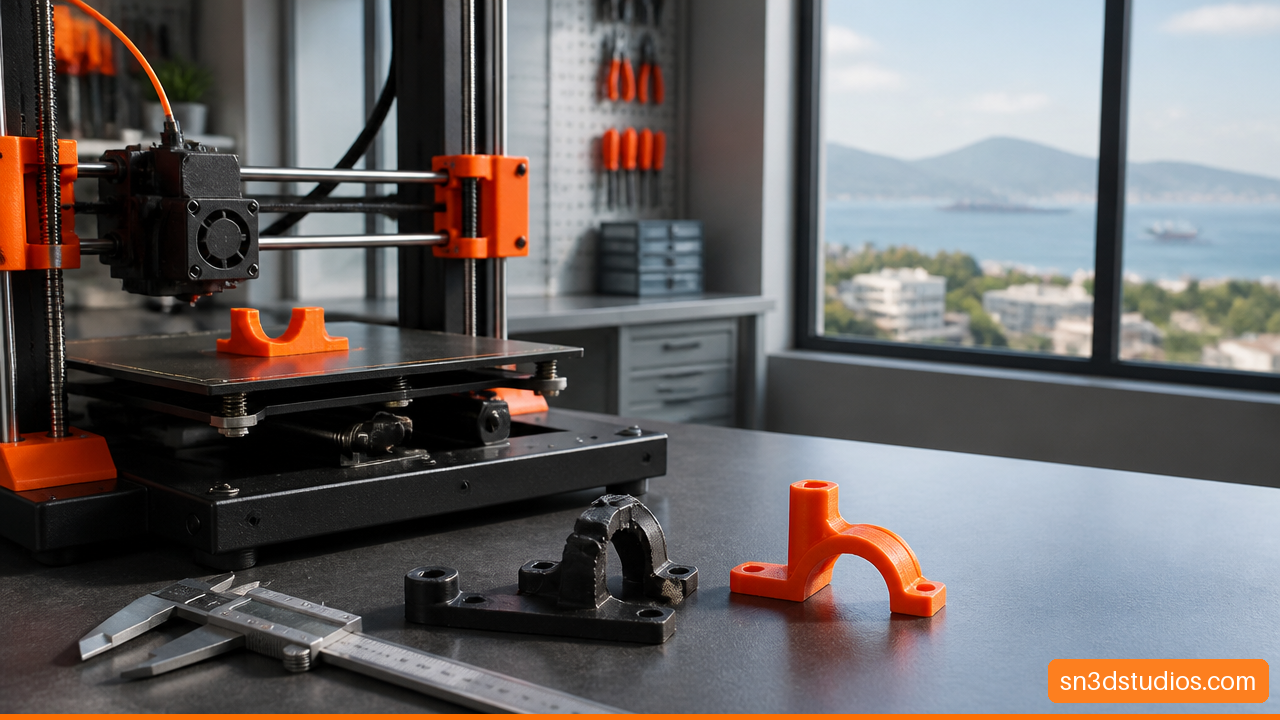
An on demand 3D printing service for replacement parts in Vizag can be a practical option when an original component is broken, discontinued, delayed, or only needed in a small quantity. I recommend treating it as an engineering decision, not simply a printing job. A part must fit correctly, handle its real working conditions, and be safe for its intended use.
Table Of Contents
• When 3D Printing Is A Good Replacement Option
• Prepare A Replacement Part For Accurate Reproduction
• Choose Materials And Processes By Working Conditions
When 3D Printing Is A Good Replacement Option
Start With The Part’s Actual Job
I would consider on demand production for low volume, hard to source, or customized items such as a cabinet latch, sensor cover, cable guide, appliance knob, small bracket, enclosure, or machine guard cover. It can be especially useful when waiting for an imported spare part stops a noncritical task.
The decision changes when the original part carries a serious risk. A printed polymer replacement may be unsuitable for brake components, pressure vessels, high voltage insulation, lifting hardware, fuel system parts, medical devices, or parts where failure could injure someone. In those cases, the original manufacturer part, a qualified metal component, or CNC machining may be the safer path.
A replacement part should be accepted based on load, heat, chemicals, wear, and safety exposure, not because it looks similar to the original.
For example, a broken plastic clip inside a desk fan housing may be a reasonable print candidate. A clip holding a hot electrical connection is different: heat, electrical behavior, and failure consequences matter more than shape alone.
Verify What “Local” Means
Vizag has listings for custom printing, functional parts, and spare parts. The BY3D Printing & Interior Designing listing identifies functional parts and spare parts as advertised uses, but a local listing alone does not confirm where the part will be produced or how it will be inspected.
I suggest asking whether the job is printed in Visakhapatnam, routed to another city, or produced through a partner network. This affects turnaround, test fitting, pickup, and the ease of correcting an issue. FabFlow’s Visakhapatnam service page describes file uploads, communication with fabricators, production tracking, and delivery or pickup, which makes this distinction worth confirming before ordering.
Use A First Article Before Ordering Multiples
For any part with holes, clips, shafts, threads, or mating surfaces, I recommend ordering one first article before requesting a batch. A first article is the initial part used to check fit and function.
A sensible approval sequence is:
- Print one part in the selected material and orientation.
- Measure key dimensions after printing and post processing.
- Test it on the real assembly without forcing it into place.
- Check motion, clearance, fastening, and contact points.
- Record any changes before producing additional units.
Public local service pages do not appear to publish standardized fit approval methods or verified tolerance data. That does not mean a provider cannot inspect a part; it means I would ask what they will measure, what tolerance is realistic, and whether one revision is included in the quote.
Prepare A Replacement Part For Accurate Reproduction
Send A Measurement Package, Not Just Photos
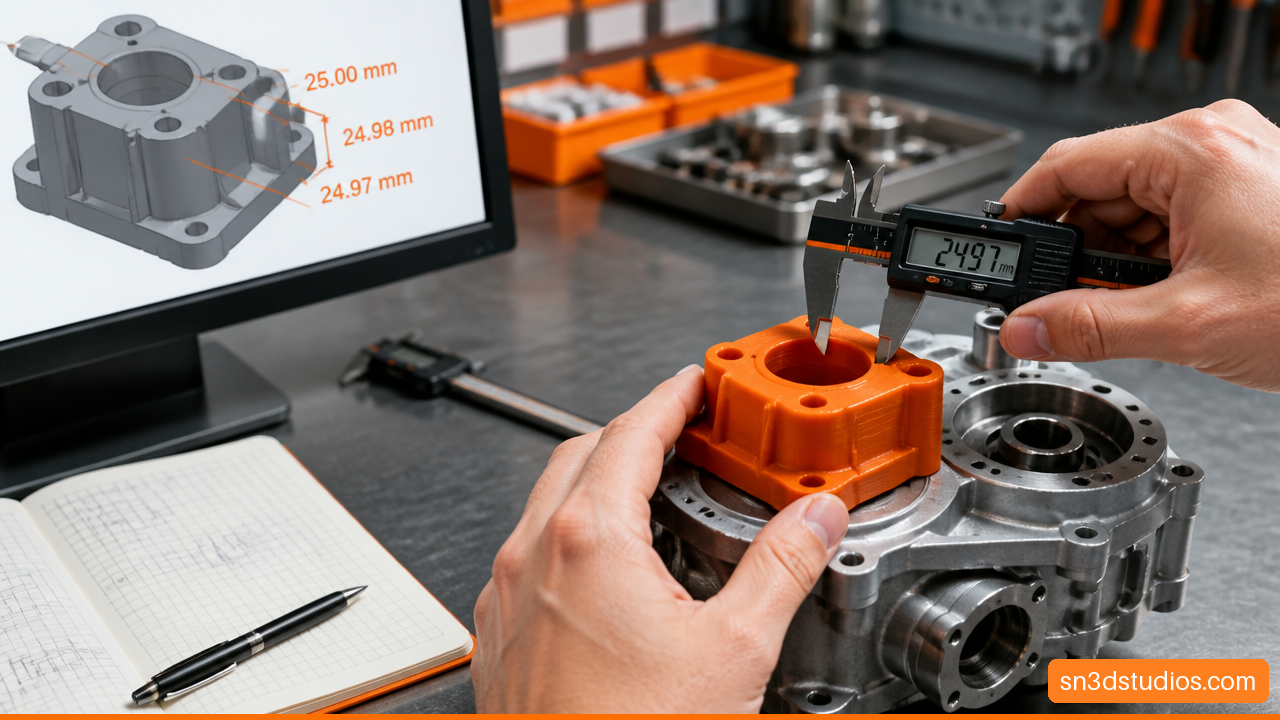
Photos help identify the part, but they rarely control fit. Perspective distortion can hide depth, thread pitch, wear, and small offsets. I recommend sending photographs alongside a controlled measurement package.
| What To Provide | Why It Matters | Example |
|---|---|---|
| Overall length, width, and height | Sets the basic part envelope | A 62 mm cover cannot be replaced by a 60 mm print if it seats inside a fixed recess |
| Hole diameter and center spacing | Controls screws, pins, and shafts | Two mounting holes may look aligned but be 1 mm apart from the required spacing |
| Datum surface or reference edge | Keeps measurements consistent | Measure all hole locations from the flat bottom face |
| Thread type and engagement depth | Prevents loose or damaged fastening | A printed boss may need tapping rather than directly printed threads |
| Intended load and environment | Guides material selection | A wet outdoor clip needs different planning than an indoor display knob |
A datum is a stable reference surface, axis, or feature used to take measurements. If a broken part has one undamaged mounting face, use that face as the datum. Measure hole centers and edges from it instead of measuring each feature from a different side.
SN 3D Studios’ custom design workflow describes submitting requirements, dimensions, sketches, reference images, or an existing 3D file for design, printing, and refinement support. That is useful when a customer has an idea or damaged sample but no CAD model.
Reverse Engineering Is More Than Scanning
A 3D scan captures visible geometry. It does not automatically create a clean, working replacement part. Worn surfaces, hidden holes, internal ribs, and bent tabs can make a scan inaccurate if copied without review.
The better route is often scan to CAD. The scan is used as a reference, while a CAD model rebuilds important interfaces: mounting faces, shaft diameters, clearance holes, clips, and thread locations. This makes later changes easier too.
Consider a worn gear cover. A scan may reproduce scratches and deformation that occurred during years of use. A CAD rebuild can preserve the mounting pattern while restoring flat sealing surfaces and intended wall thickness. I would ask whether the service can model these functional features rather than only create a mesh copy.
Choose Materials And Processes By Working Conditions
Material Names Do Not Guarantee Performance
PLA, ABS, nylon, resin, and metal are not interchangeable labels. Print orientation, wall thickness, infill, drying, curing, and post processing affect the final part. Layer based parts can be anisotropic, meaning they may be stronger along one direction than another. A bracket printed flat may fail differently from the same bracket printed upright.
Creep also matters. Under constant force, some polymers slowly deform over time. A lightly loaded indoor hook may work well, while a tight clamp or spring like clip can lose tension after repeated heat and load cycles.
| Need | Often Worth Considering | When To Avoid Or Recheck |
|---|---|---|
| Low cost indoor cover or knob | FDM thermoplastic | Avoid for high heat or fine sealing surfaces without testing |
| Fine detail, small visual part | SLA resin | Recheck brittleness, UV exposure, and impact needs |
| Complex functional polymer part | SLS or MJF polymer | Confirm availability, finish, price, and actual required strength |
| High heat, heavy wear, or metal interface | Metal printing or CNC machining | Confirm inspection, material grade, and whether additive manufacturing is appropriate |
Kreate 3D’s Visakhapatnam page advertises FDM, SLA, SLS, MJF, DMLS, and 3D scanning. I would still ask whether the specific process is available for your order, produced locally, inspected, and suitable for a one piece replacement. A provider listing DMLS does not automatically mean every metal part is accepted or qualified.
Compare Quotes On Total Cost, Not A Headline Rate
A quote can include CAD work, scanning, material, supports, machine time, finishing, failed print risk, delivery, and fit revisions. This is why a per gram price is not a full replacement part price.
The IndiaMART listing for T3D Labs Private Limited shows indicative rates using different units, including grams for some processes and cubic centimeters for another. Those listed figures are not verified final quotes or proof of part performance. I would compare proposals using the same scope: one part or batch, design included or not, material grade, finishing, shipping, and revision policy.
Ask for a written quote that separates these items. A lower print price can become the more expensive choice if the model needs substantial redesign after a failed fit test.
Key Takeaways
Make The Replacement Decision Before The Print Decision
• Choose 3D printing for low volume, custom, discontinued, or noncritical replacement parts where fit can be tested.
• Avoid unqualified printed replacements for safety critical, pressure bearing, high temperature, electrical, or high load applications.
• Provide dimensions from a consistent datum, plus hole sizes, thread details, photographs, and the part’s working conditions.
• Approve a first article before ordering several pieces, especially for clips, threads, brackets, and mating parts.
• Confirm local production, process availability, inspection, finishing, total price, and revision terms before placing an order.
Frequently Asked Questions
Can I Get A Broken Or Discontinued Replacement Part 3D Printed In Vizag?
Yes, often for a noncritical part if enough information is available to model and test it. A broken original, measurements, clear photographs, sketches, or an existing CAD file can help. The key question is whether the replacement can safely handle its actual load, heat, moisture, friction, and use cycle.
Do I Need A CAD File To Order A Replacement Part?
No. A CAD file speeds up the process, but it is not always required. A service may be able to create or refine a model from dimensions, a sample part, images, or a sketch. I would expect additional design time and recommend approving the CAD view or first article before production.
Can A Service Recreate A Part From A Broken Original?
Sometimes. If mounting points and key interfaces are intact, reverse engineering can rebuild the intended geometry. If the sample is badly worn, missing sections, or distorted, the model may require assumptions. For example, a cracked handle can be recreated visually, but its hidden fastening method may need measurement from the appliance rather than guesswork.
Is FDM Strong Enough For A Mechanical Spare Part?
It can be strong enough for some housings, guides, light brackets, and low stress fixtures. It is less predictable for parts exposed to impact, sustained force, heat, or repeated bending. Ask about print orientation, wall count, infill, layer adhesion, and the expected failure direction instead of relying on a generic strength claim.
How Long Does A Replacement Part Take?
Timing depends on design work, process, material, queue, finishing, delivery, and whether a fit revision is needed. A simple model with a ready CAD file may move faster than a part requiring scanning and reconstruction. I would request a schedule for design approval, first article, revision, and final delivery rather than relying on a broad turnaround promise.
Sources And References
• SN 3D Studios — Custom 3D Printing & Design: https://sn3dstudios.com/
• 3Ding — BY3D Printing & Interior Designing, 3D Printing Services in Visakhapatnam: https://3ding.in/spots/by3d-printing-interior-designing/
• Kreate 3D — 3D Printing and 3D Scanning Services in Visakhapatnam: https://kreate3d.in/3d-printing-and-3d-scanning-services-in-visakhapatnam/
• FabFlow — 3D Printing Services in Visakhapatnam: https://www.fabflow.app/3d-printing-services/visakhapatnam
• IndiaMART — T3D Labs Private Limited, Visakhapatnam: https://m.indiamart.com/dakshaonlineservices/about-us.html