
Small Batch 3D Printing Service for Product Manufacturers in Vizag
A small batch 3D printing service for product manufacturers in Vizag can help you test, improve, and produce parts without paying for expensive tooling first. The best fit is not simply the supplier with the most listed processes. It is the supplier that can match your part’s function, material, finish, inspection needs, and delivery deadline.
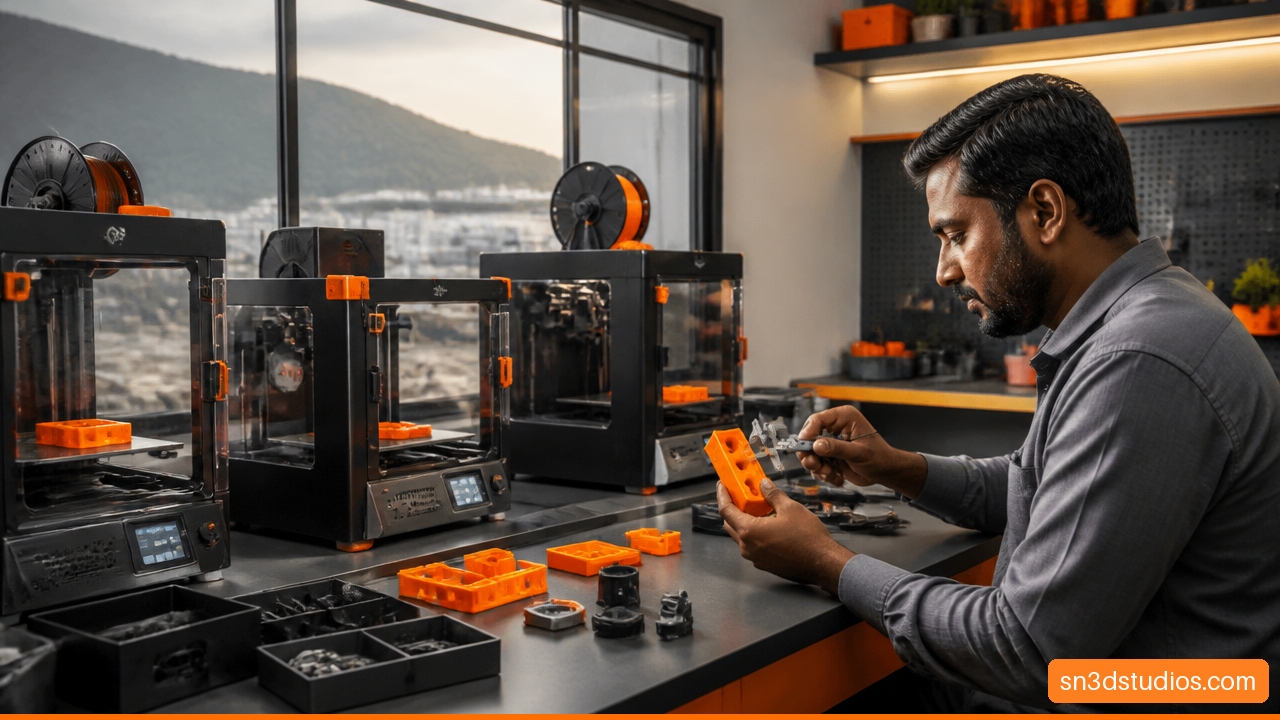
Table Of Contents
• Choose The Right Process For The Part
• Build A Manufacturing Grade RFQ
• Check Quality Before Ordering A Full Batch
• Key Takeaways
• Frequently Asked Questions
Choose The Right Process For The Part
Small batch production means more than printing a few copies. A prototype can prove that a shape looks right. A repeatable batch must also meet the same fit, strength, surface, and assembly needs from part to part.
Before comparing quotes, define what the part must do. A display model, a drill guide, a heat exposed enclosure, and a load bearing bracket may look similar in CAD, but they need very different materials and print settings.
Match The Process To Product Function
| Part Need | Typical Process | Suitable Material Direction | What To Confirm Before Ordering |
|---|---|---|---|
| Low cost fit check or fixture | FDM | PLA, PETG, ABS, engineering filaments | Layer direction, wall thickness, warping risk |
| Smooth visual model or detailed housing | SLA | Standard or tough resin | Resin durability, curing method, surface finish |
| Functional polymer batch with complex geometry | SLS or MJF | Nylon based powder materials | Dimensional consistency, dyeing, finishing |
| High strength metal component | DMLS or machining | Metal alloy chosen for the application | Material documentation, machining needs, inspection |
| Tight fit, threaded feature, or precision surface | CNC machining | Production grade plastic or metal | Drawing tolerances and measurement plan |
FDM is often practical for jigs, enclosures, brackets, and early production parts because it is widely available and can be economical. But FDM parts are anisotropic: they can be weaker across layer lines than along them. If a bracket will be pulled apart, do not place the load across the layers without testing the orientation.
SLA can produce sharp detail and smoother surfaces, which helps for product appearance models and compact features. It is less suitable when a part will face repeated impact, outdoor exposure, or constant heat unless a resin made for that use is selected and validated.
SLS and MJF are worth comparing for complex functional batches because powder based processes do not need the same support structures as FDM or SLA. That can reduce marks on difficult shapes. Still, ask how parts will be cleaned, finished, and inspected.
For larger manufacturing choices, think3D’s overview of its Visakhapatnam facility describes additive processes alongside CNC machining, vacuum casting, and injection molding. That matters because 3D printing is not always the lowest total cost option.
Know When To Use Another Manufacturing Method
I recommend comparing alternatives when one of these conditions applies:
- Use CNC machining when the part needs close tolerances, a precise bearing seat, strong threads, or uniform strength in every direction.
- Use vacuum casting when you need a modest number of polymer copies with a more molded appearance after a master pattern is approved.
- Use injection molding when demand is stable and quantities are high enough to justify tooling. The tool cost can be large, but the per part cost may fall sharply at higher volumes.
A simple example: 20 custom cable guides may suit FDM printing because design changes are still likely. If the design is fixed and demand rises to hundreds or thousands, a molded process may deserve a cost comparison.
Build A Manufacturing Grade RFQ
A vague request such as “print 50 pieces in strong plastic” usually leads to a vague quote. An RFQ should give the supplier enough detail to plan build orientation, support strategy, finishing work, and inspection.
Include The Details That Change Cost And Quality
Use this checklist before sending your request:
• CAD file in STEP, STL, or 3MF format, plus a PDF drawing when dimensions matter
• Part number, revision number, and required quantity
• Intended use, including load, impact, temperature, moisture, chemicals, or sunlight
• Critical dimensions, hole sizes, thread requirements, and tolerance limits
• Preferred material and acceptable alternatives
• Surface finish needs, such as sanding, painting, dyeing, inserts, tapping, or assembly
• Delivery location in Vizag or elsewhere, target date, and packaging requirements
• First article approval and dimensional inspection expectations
If you only have a sketch, photo, physical sample, or idea, state that clearly. SN 3D Studios describes a workflow that starts with requirements, dimensions, intended use, sketches, or 3D files before design preparation, printing, and refinement. That is useful when a printable CAD model does not yet exist.
Calculate Total Landed Cost, Not Just Print Price
Machine time is only one line item. The actual batch cost can include CAD cleanup, failed build allowance, support removal, curing, sanding, inserts, painting, inspection, packaging, and delivery.
A low unit quote can become expensive if the parts arrive without the required inserts, finish, or dimensional checks.
Ask for the quote to separate these items where possible. For example, a supplier may quote an enclosure at one price, while post processing and brass inserts are priced separately. That is not automatically a problem. It becomes a problem only when those needs are discovered after approval.
Published local information does not consistently show standard prices, minimum order quantities, lead times, guaranteed tolerances, or repeatability data. Treat any estimate as project specific until the supplier confirms it in writing.
Check Quality Before Ordering A Full Batch
A supplier may advertise a process, but that alone does not prove current machine capacity or batch control. Local providers do show relevant options: Blaster 3D’s company profile identifies Visakhapatnam and describes rapid prototypes and functional parts for startups and engineers, while Vizag 3D Prints advertises PLA, ABS, resin, prototypes, custom gadgets, and functional parts in Visakhapatnam. For a manufacturing order, verify the details behind those listings.
Use A First Article Before The Full Run
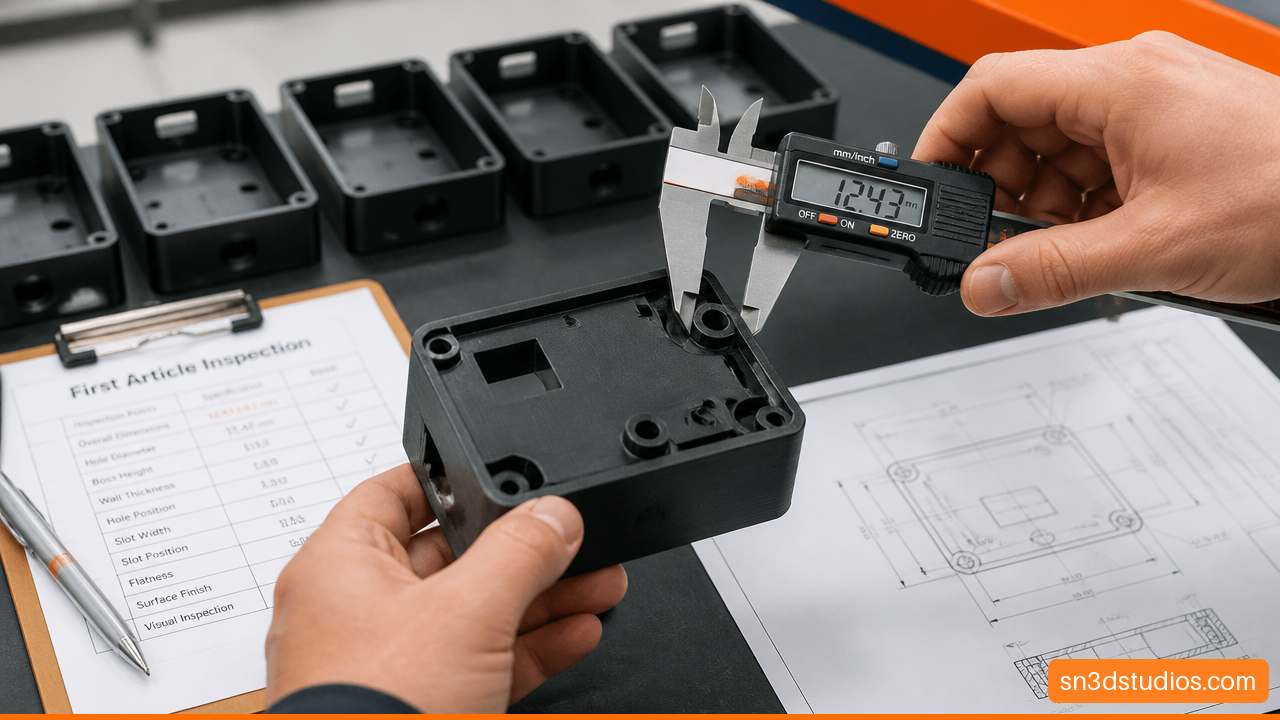
For a new product, order one or a small number of sample parts first. Measure critical features against your drawing, test mating parts, and check the finish under real lighting.
A first article is especially useful for snap fits, threaded joints, sealing faces, press fit inserts, and parts that attach to existing equipment. A hole that is only slightly undersized may be acceptable in a visual model but can stop an assembly line fixture from working.
Ask The Supplier These Questions
- What machine and process will produce this batch?
- What material brand or grade will be used, and can it be documented?
- Which dimensions will be inspected, and how will they be measured?
- Will the same build orientation and settings be used for every batch?
- What happens if parts warp, crack, or fail the agreed acceptance criteria?
- Can you provide photos or measurements of the first article before full production?
Fair warning: no printing process removes the need for good design. Thin walls can warp, deep holes can print undersized, unsupported overhangs can sag, and sharp corners can concentrate stress. Design for Additive Manufacturing means adjusting geometry before production rather than trying to fix every issue after printing.
Key Takeaways
• Choose the printing process based on function, not just appearance or unit price.
• Use FDM for many economical fixtures and enclosures, but account for layer direction and strength.
• Request a first article when dimensions, assembly, or repeat orders matter.
• Ask for a quote that includes finishing, inspection, packaging, and delivery costs.
• Compare CNC, vacuum casting, and injection molding when volume, finish, or tolerance needs change.
• Confirm machine availability, material choice, and defect handling before committing to a full batch.
Frequently Asked Questions
Which 3D Printing Service In Vizag Is Suitable For Small Batch Product Manufacturing?
Choose a provider based on the exact process, material, finishing, and inspection your part needs. Do not rely only on a directory listing or a general claim of “industrial printing.” Ask for a sample, current capacity confirmation, and a written batch plan.
Can A Vizag Provider Make Functional End Use Parts?
Yes, some locally advertised services describe functional parts, but suitability depends on the load, heat, environment, and required life of the part. Functional use should be validated with a sample and, where needed, physical testing before release.
What Information Should I Include In A 3D Printing Quote Request?
Include the CAD file or drawing, quantity, material preference, critical dimensions, intended use, finish, delivery date, and inspection needs. If the product will carry load or face heat, state the expected conditions rather than only asking for “strong” material.
How Long Does A Small Batch Usually Take?
Timing depends on part size, quantity, machine availability, print duration, post processing, and whether a first article is approved first. Ask for separate dates for design approval, first article, full batch completion, and dispatch. This avoids confusing print time with total delivery time.
What Should I Do If The Delivered Batch Has Defects?
Document the issue with photos, measured dimensions, part numbers, and the approved drawing or sample. Compare the defects against agreed acceptance criteria, then request a clear response on sorting, rework, replacement, or reprint. This is much easier when quality expectations were agreed before production.
Sources/References
• SN 3D Studios — Custom 3D Printing & Design: https://sn3dstudios.com/
• Blaster 3D — LinkedIn company profile: https://www.linkedin.com/company/blaster-3d
• Vizag 3D Prints — Architectural Model Scale: https://vizag3dprints.carrd.co/
• think3D — Overview of think3D: https://www.think3d.in/overview-of-think3d/