
How To Order A Small Production Run Of 3D Printed Parts
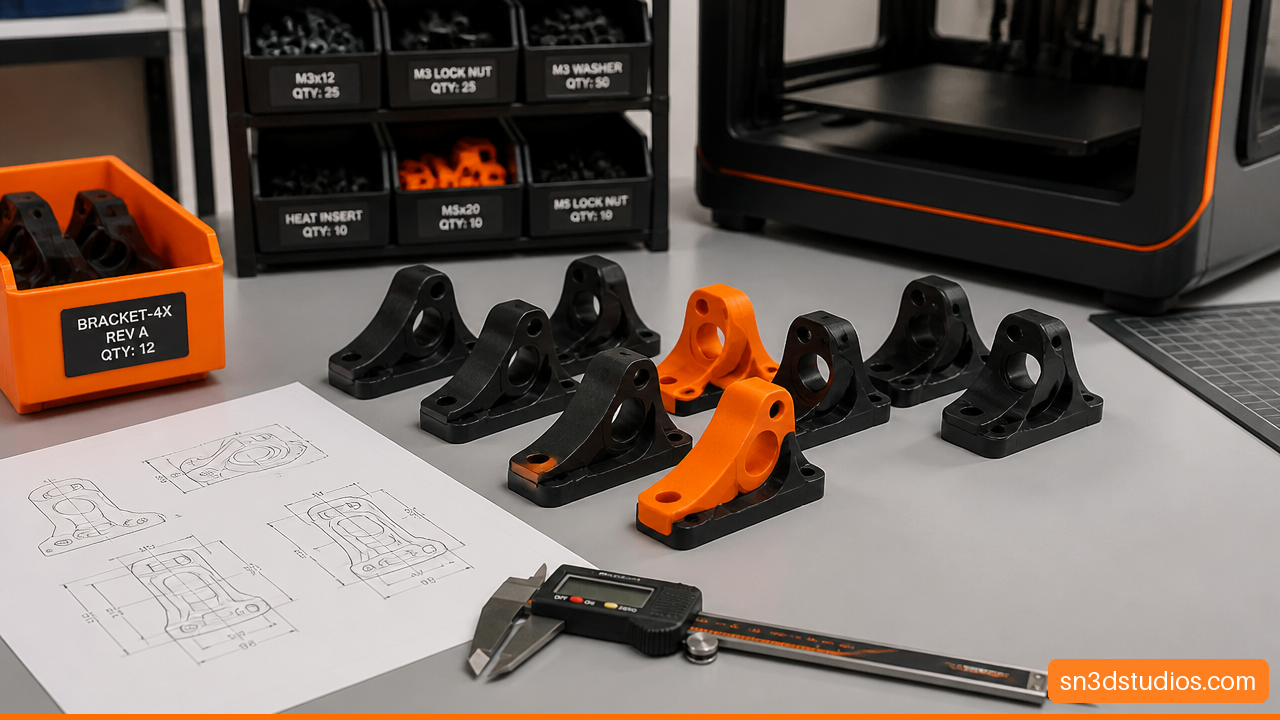
Learning how to order a small production run of 3D printed parts starts with more than uploading a CAD file. A reliable order needs a controlled design revision, clear material requirements, an approval step, and a plan for how parts will be inspected and delivered. I recommend treating the order like a compact manufacturing project, even if you only need 10 or 50 parts.
Table Of Contents
• Prepare A Production Package
• Choose The Right Process And Quote
• Approve Parts And Control The Batch
Key Takeaways
• Use one controlled production package that includes the model, drawing, revision, material, finish, inspection needs, and delivery instructions.
• Do not assume a fit check printed in one material will predict the fit of the final production material.
• Compare total landed cost, not only the lowest price per part.
• Approve a representative first article before releasing the full batch when fit, appearance, or function matters.
• Define what an acceptable delivered part looks like before production begins.
Prepare A Production Package
A small production run can mean a handful of parts, several dozen, or more. There is no single industry quantity that defines it. What matters is that you need repeatable parts without paying for dedicated injection molding tooling.
The first step is to create a production package. This is the complete set of instructions a supplier needs to manufacture the correct version of a part. Sending only an STL file can work for a simple display model, but it leaves too much open to interpretation for functional parts.
Freeze The Correct Revision
Give every part a part number and revision. For example, use BRKT 100 Rev B for a mounting bracket and make sure the CAD file, drawing, quote, and purchase order all use the same identifier.
A controlled package should include:
• A CAD file, usually STEP for editable solid geometry or STL for print ready geometry
• A drawing showing overall dimensions, critical dimensions, hole sizes, threads, and tolerance notes
• The requested quantity for each variant or SKU
• Material, color, surface finish, and intended use
• Notes about cosmetic faces, orientation limits, or surfaces that must stay support free
• Inspection requirements and packaging instructions
A small batch RFQ checklist from JC Print Farm similarly calls for controlled files, quantities, application conditions, critical features, inspection, packaging, destination, timing, and expected repeat demand.
Separate A Fit Check From A First Article
A fit check prototype is an early part used to test assembly, clearance, grip, or basic shape. It can be printed quickly and cheaply. A first article is different: it should be made using the intended production material, process, finish, and key settings.
That difference matters. A prototype might confirm that a cover snaps onto an enclosure, but it may not prove that a production batch will fit if the production process changes.
A fit check answers, “Does the design concept assemble?” A first article answers, “Should I authorize this manufacturing setup?”
For a part with low risk, such as a simple label holder, you may go straight to the batch. For a clip, sealing feature, threaded part, or customer facing enclosure, I suggest approving a first article before authorizing the remaining quantity.
Specify The Delivered State
The printed geometry is not the whole order. State how the parts should arrive.
OmniTechs recommends identifying each variant, quantity, revision, material, intended use, delivery condition, and preferred date. Delivery condition can include loose parts, labeled sets, hardware packs, assembled units, or finished and cleaned components.
For example, if each installation kit needs two brackets, four screws, and one label, ask for kitting rather than receiving one box of loose printed parts. It may cost more, but it can reduce sorting time and packing errors later.
Choose The Right Process And Quote
The best process depends on the part’s job, not just its shape. Consider load, heat, chemical contact, appearance, dimensional needs, and expected use cycles.
Match The Process To The Part
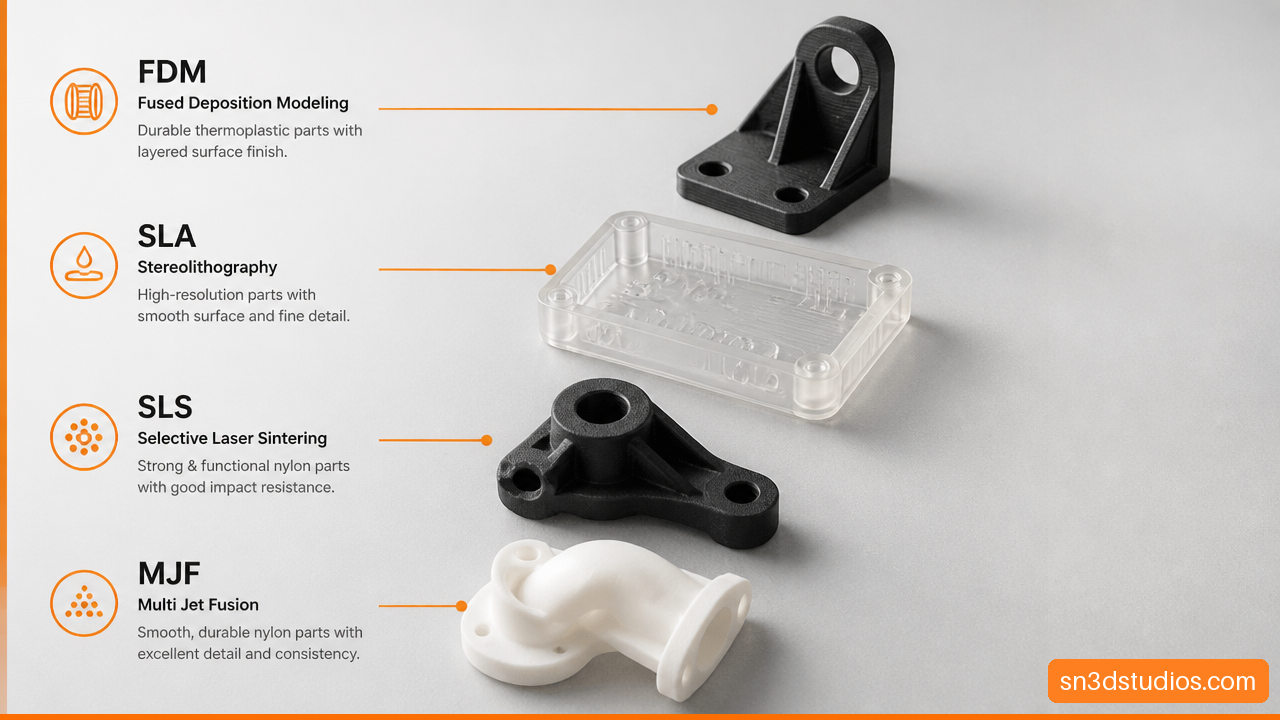
| Process | Often Suitable For | Watch For |
|---|---|---|
| FDM | Larger functional parts, fixtures, housings, and lower cost prototypes | Visible layers, direction dependent strength, support marks |
| SLA Resin | Detailed models, cosmetic prototypes, and fine features | Resin properties vary, and some parts may be less suitable for long term stress |
| SLS | Complex nylon parts, interlocking forms, and small batches | Surface can feel slightly grainy and finishing may be needed |
| MJF | Functional polymer parts and repeatable low volume production | Color and finish options may require post processing |
| Metal Printing | Heat, strength, or specialized performance needs | Higher cost, longer processing, and added finishing needs |
Use FDM when cost and part size matter more than a polished surface. Use SLA when small details or smooth surfaces matter, but confirm that the resin is suitable for the real use environment. Consider SLS or MJF when you need multiple functional polymer parts with complex geometry and more consistent batch planning.
Do Not Assume Materials Behave The Same
Changing from a prototype material to a production material can alter stiffness, shrinkage, appearance, and fit. BuildplateCo notes that material changes can affect shrinkage, stiffness, and fit, while print time, material use, supports, and batch layout also affect the estimate.
Consider a lid that fits well in a rigid prototype resin. Moving it to nylon for production may change flexibility and clearance. The answer is not always to avoid the material change. Instead, test the intended production combination before approving the full run.
Compare Landed Cost, Not Unit Price
A low unit price can hide charges that matter in a small order. Ask suppliers to show the full delivered cost.
| Quote Line | Why It Matters |
|---|---|
| Part production | The direct cost of making each part |
| Setup or engineering review | Can be meaningful when the batch is small |
| Post processing | Covers sanding, dyeing, curing, threading, or finishing |
| Inspection | May include dimensional checks or reports |
| Packaging and kitting | Important when parts must arrive in usable sets |
| Shipping, tax, and duties | Determines the real delivered cost |
Ask for the accepted quantity as well. If you need 30 usable parts, clarify whether the supplier will make exactly 30 or include spare parts to account for inspection failures. There is no universal rejection allowance for additive manufacturing, so this should be agreed in writing.
Approve Parts And Control The Batch
A good production order has a clear approval gate. This prevents a supplier from making the full quantity while basic questions about fit, finish, or tolerances remain unresolved.
Build A Simple Acceptance Plan
An acceptance plan states how you and the supplier will decide whether parts conform. It does not need to be complicated, but it should be specific.
Include:
- The exact revision being produced.
- Critical dimensions and their acceptable tolerance.
- Cosmetic requirements, such as visible faces that cannot have support scars or discoloration.
- The quantity to inspect and whether you need a report.
- The remedy if the first article fails, such as redesign review, reprint, or quote revision.
- Packaging, labels, and delivery requirements.
Do not use a vague instruction like “inspect all parts carefully.” Instead, identify what matters. For a mounting bracket, that may mean checking the hole spacing, flat mating face, and thread engagement. Minor layer texture on a hidden face may be acceptable.
Ask What Will Be Controlled
For repeatable production, ask what the supplier will record or hold constant. Useful questions include:
• Will the same material grade and color be used throughout the run?
• Will the part orientation and finish method be maintained?
• Can the supplier retain the approved first article or photos as a reference?
• Is batch traceability available if a problem is found later?
• What happens if material availability requires a substitution?
Makelab describes production workflows that can include engineering review, material and tolerance requirements, dimensional sampling, batch production, and scheduled repeat deliveries. Those controls are valuable only when they are written into the order and tied to your approved revision.
Plan Repeat Orders Carefully
Once the first batch works, freeze the released revision and retain a reference sample if appearance or fit is especially important. Reorder using the same part number, revision, quantity, material, finish, and delivery notes.
If demand is uneven, consider ordering in planned releases instead of placing one oversized batch. This reduces storage risk and gives you room to revise the part if field feedback shows a problem. Avoid changing CAD, material, and process at the same time. If something changes, make that change visible as a new revision and consider another first article.
Frequently Asked Questions
What Quantity Counts As A Small Production Run?
There is no fixed number. A small run may be 5 parts for a specialized fixture or 100 parts for a product launch. Define it by your need for a limited, repeatable batch without permanent tooling.
Should I Order A Prototype Or A First Article?
Order a fit check prototype when you need to test shape or assembly early. Order a first article when the final material, process, dimensions, finish, and production setup need approval before the full batch is released.
Which File Format Should I Send?
Send a STEP file when possible because it preserves solid geometry for review. Send an STL when it is the approved print geometry. Include a PDF drawing for critical dimensions, tolerances, and notes that are not obvious from the model.
How Should I Specify Tolerances And Critical Dimensions?
Mark only the dimensions that control function, fit, sealing, alignment, or safety. Put their tolerance directly on the drawing. Asking for extremely tight tolerances everywhere can increase cost without improving the part’s real performance.
When Should I Consider Injection Molding Instead?
Consider it when demand is stable, volumes are high enough to justify tooling, and the part design is unlikely to change. There is no universal break point because tooling cost, material, geometry, finish, and expected volume all vary. For example, a simple high volume cap may favor molding sooner than a complex low demand service part.
Sources And References
• JC Print Farm — Small Run 3D Printing Manufacturing: https://www.jcprintfarm.com/pages/small-batch-manufacturing
• OmniTechs — Small batch 3D printing: From prototype to production: https://omnitechs.nl/en/small-batch-3d-printing
• BuildplateCo — Low Volume 3D Printing: https://buildplateco.com/low-volume-3d-printing/
• Makelab — Production 3D Printing Service: End Use Parts: https://www.makelab.com/applications/production-parts